
Writing task 1
The table gives data on the quantity of male and female workers and factories that produced silk over 50-year period from 1851 to 1901 in England and Wales.
Overall, the number of total employees went through an reduction throughout the period while there was a period of fluctuation in factories.
About 53.964 men and 76.786 women produced silk in 1851. In the next 20 years, both categories witnessed an drop of more than 20.000 employees and leaded to 38.102 for male and 53.310 for their counterparts. However from 1881 to 1891, while the number of female workers continue to declined to 30.336 people, male employees minimally increased to 28.689 people and after 10 years, both features dropped to 13.375 and 25.567 respectively. These leaded to the total of workforce from 1851 to 1901 dramatically plummeted from 130.750 workers to only 38.942 workers.
While the statistics of manufactories saw a unsteady phase in the range between 200 and 800. Only about 272 factories produced silk in 1851 but within 10 years, it significantly increased to 761 manufacturing facilities. In the next 30 years, the quantity of factories slightly fluctuated between 600 to more than 700.
In conclusion, while manufacturing facilities had the minimal fluctuation, total number workforce underwent a dramatic reduction.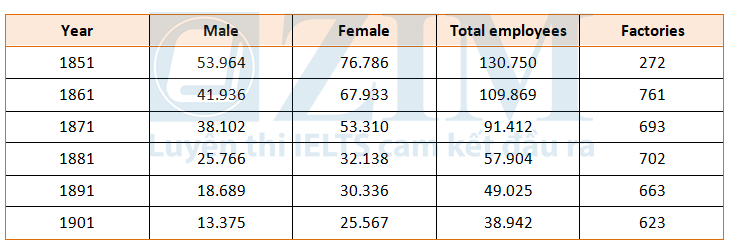
Get the Weekly English Kit 📬
New words, one handy idiom, and a 2-minute quiz — delivered to your inbox to keep your streak alive.
 Related Questions