
Writing Task 1
[Please review it for me, thanks a lot]
The graph below shows the proportion of the population aged 65 and over between 1940 and 2040 in three different countries.
The current assumption is that in 2050.
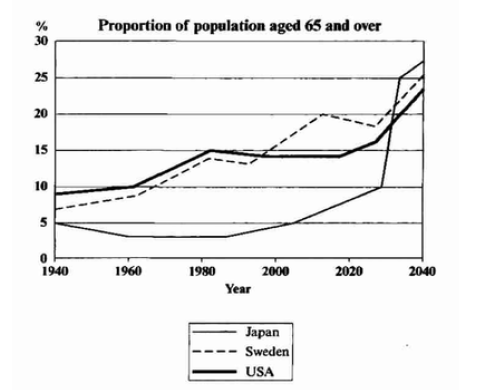
The line graph illustrates the percentage of people aged 65 and older from 1940 out to 2040 in three different countries.
Overall, the proportion of the population aged 65 and older all three countries increased over the period of 100 years. It can be seen that Japan had a dramatic growth in the elderly population.
It can be seen from the graph, between 1940 and early 2000, there was a gradual increase in the percentage of population aged 65 and over in the USA from below 10% to nearly 15%. With the similar trend, the proportion of elderly people in Sweden grew slowly from about 7% to approximately 13%. By contrast, that for Japan declined slightly and remained below 5% throughout this period.
In the remainder of the period, the proportion of elderly population in Sweden increased rapidly to above 25% in 2040. In the other hand, the figure for the USA remained unchanged below 5% until 2020, but it climbed sharply to reach about 23% in the last year of the graph. After the period with a slight increase, the percentage of people aged 65 and older in Japan grew dramatically to its highest point of approximately 27%.
Top answer
The line graph illustrates the percentage of people aged 65 and older from 1940 out to 2040 in three different countries. Overall, the proportion of the population aged 65 and older in all three countries increased over the period of 100 years. It can also be seen that Japan had a dramatic growth in the elderly population.
- The line graph illustrates the percentage of people aged 65 and older from 1940 out to 2040 in three different countries.
- Overall, the proportion of the population aged 65 and older in all three countries increased over the period of 100 years.
- It can also be seen that Japan had a dramatic growth in the elderly population.
- It can be seen from According to the graph, between 1940 and early 2000, there was a gradual increase in the percentage of population aged 65 and over in the US A, from just below 10% to nearly 15%.
- With the a similar trend, the proportion of elderly people in Sweden grew slowly from about 7% to approximately 13%.
Get the Weekly English Kit 📬
New words, one handy idiom, and a 2-minute quiz — delivered to your inbox to keep your streak alive.
The line graph illustrates the percentage of people aged 65 and older from 1940 out to 2040 in three different countries.
Overall, the proportion of the population aged 65 and older in all three countries increased over the period of 100 years. It can also be seen that Japan had a dramatic growt
 0
0Lê Anh Dungelderly people
These days, 65 is not considered to be elderly. I would not use the word "elderly."
Lê Anh DungOverall, the proportion of the population aged 65 and older all three countries increased over the period of 100 years.
Do not use past tense fo
0Lê Anh DungThe current assumption is that in 2050.
I think OP means that we should assume we are in 2050 now, so looking at the graph from a future-to-past point of view, hence using the past tense.
0 Related Questions