
Writing Part 1 IELTS - Line graph. I truly appreciate your help.
Hi, I'm grateful that you spent time and effort giving me advice on my clumsy writing. I look forward to learning more from my mistakes. Thank you and have a day as lovely as you.
Task 1: The line graph illustrates the proportion of total expenditure in a certain European country between 1960 and 2000.
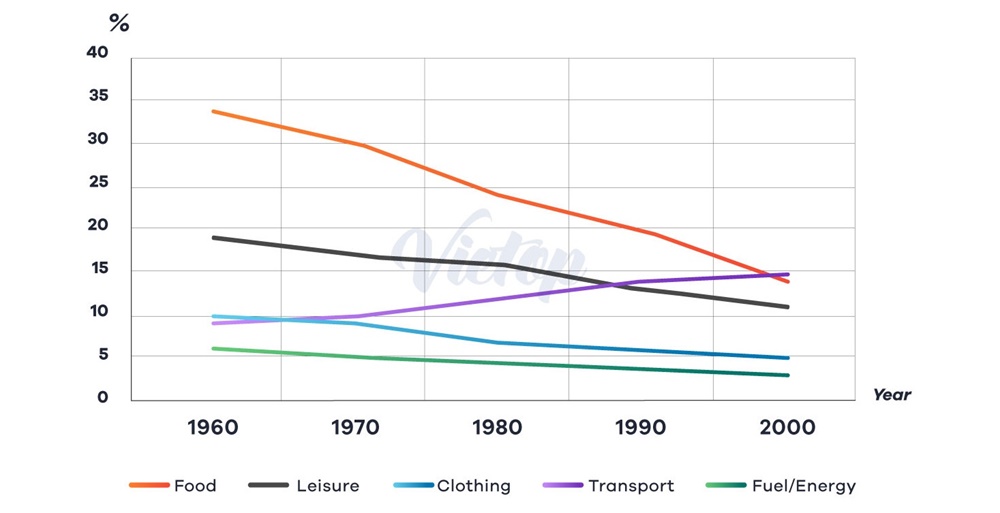
The line graph shows the percentage of a certain European country’s expenditure on food, leisure, clothing, transport, and fuel/energy from 1960 to 2000.
Spending on transport was the only component that increased in the end, while food and leisure expenditure had a downward trend. Meanwhile, people gradually decreased the amount of money spent on clothing and fuel/energy throughout the period.
Specifically, in 1960, about 34% of the expenditure was used for food, 1.8 times that of leisure. However, in the next 40 years, this category showed a rapid decline and ended at around 14% in 2000. By contrast, after a similar but slower period of decrease, leisure spending rose insignificantly in 1990 before dropping again in the following years. On the other hand, the percentage spent on transport had an upward trend and became the largest among all categories by the end of the period.
As for clothing, it took up 1 in 10 of the total expenditure, nearly as twice as the figure for fuel/energy in 1960. From that point, it remained in a relatively equivalent range with transport spending, before gradually going down and stood at only 5% in 2000. On the other hand, also in this year, only 2.5% was spent on fuel/energy, approximately half the 1960’s figure.
Top answer
The important point in this graph is to recognize that percentages and amounts are not the same, they are very different. g. " To illustrate this, suppose the total budget in 1960 is $10000.
- The important point in this graph is to recognize that percentages and amounts are not the same, they are very different.
- g.
- " To illustrate this, suppose the total budget in 1960 is $10000.
- The amount spent on food is 34% of that or $3400.
- In 2000, people are more wealthy and their total budget has increased to $30000.
Get the Weekly English Kit 📬
New words, one handy idiom, and a 2-minute quiz — delivered to your inbox to keep your streak alive.
The important point in this graph is to recognize that percentages and amounts are not the same, they are very different. Use the word "relative" to fix the problem, e.g. "relative amounts."
To illustrate this, suppose the total budget in 1960 is $10000. The amount spent on food is 34% of that or $3400. In 2000, people are more wealthy and their total budget has increased to $30000. The
 0
0 Related Questions