
0
Top answer
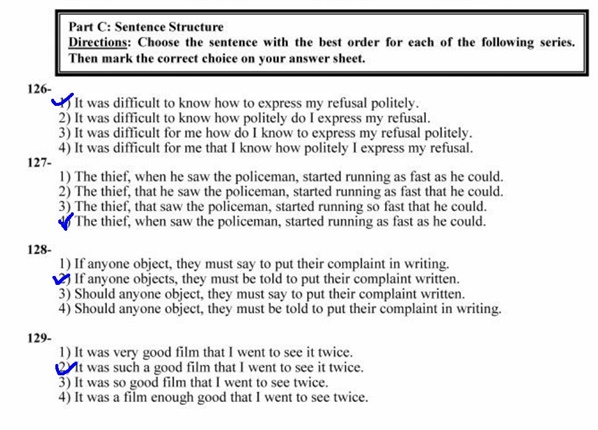
127 - 1 (Thanks, Mr. ) 128 - 4 Otherwise, OK. It's "put (something) in writing", not "put (something) written".
- 127 - 1 (Thanks, Mr.
- ) 128 - 4 Otherwise, OK.
- It's "put (something) in writing", not "put (something) written".
- CJ
Get the Weekly English Kit 📬
New words, one handy idiom, and a 2-minute quiz — delivered to your inbox to keep your streak alive.
7 Answers
0
127 - 1 (Thanks, Mr. M.)
128 - 4
Otherwise, OK.
It's "put (something) in writing", not "put (something) written".
CJ
128 - 4
Otherwise, OK.
It's "put (something) in writing", not "put (something) written".
CJ
 0
00
0
Thanks.
I thought that 'anyone' gets just the singular form of the verb.
I thought that 'anyone' gets just the singular form of the verb.
00
Persian LearnerI thought that 'anyone' gets just the singular form of the verb.The singular of 'should' is 'should'.
00
Persian LearnerI thought that 'anyone' gets just the singular form of the verb.True, but "object" is not the verb that has to agree with "anyone". This is an inversion of "anyone should object", where the modal "should" requires the bare infinitive ("object").
CJ
00
Thanks a lot.
Do we always need a subject+verb after subordinating conjunctions?
Are the following correct?
The thief, having seen the policeman, ...
The thief, seeing the policeman, ...
Do we always need a subject+verb after subordinating conjunctions?
Are the following correct?
The thief, having seen the policeman, ...
The thief, seeing the policeman, ...
00
Persian LearnerDo we always need a subject+verb after subordinating conjunctions?No, though that is probably the most commonly used structure. If you use a subject and verb, you typically have a finite verb phrase with it, but you can use a non-finite construction, i.e., a clause with a participle or infinitive.
Persian LearnerAre the
0 Related Questions