
0
Contraposition Posted 10 years ago
Vocabulary
who
Why is 'who' used here? Is it a relative or interrogative?
And is 'fool' a noun or verb?
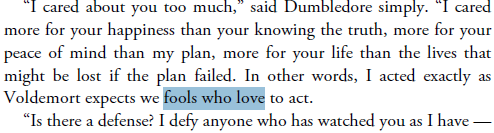
And is 'fool' a noun or verb?
Top answer
Fools is a noun; who is a relative pronoun referring to fools.
- Fools is a noun; who is a relative pronoun referring to fools.
Get the Weekly English Kit 📬
New words, one handy idiom, and a 2-minute quiz — delivered to your inbox to keep your streak alive.
7 Answers
0
0
0
contrapositionIs 'to act' the object of 'expects' or 'love'?".. I acted exactly as Voldemort expects we fools who love [to act]"
No, the infinitival clause "to act" is catenative complement of "love". 'Catenative' in this sense means chain of verbs. Objects are almost always nouns or noun phrases (cf. "...who love peace")
BillJ
 0
00
BillJNo, the infinitival clause "to act" is catenative complement of "love".Perhaps I am misunderstanding what you mean by "catentative complement", but I don't read "to act" as attaching to "love". I read the sentence like this:
I acted exactly as Voldemort expects [we fools who love] to act.
I.e., "we fools who love" is a noun phras
00
GPY BillJNo, the infinitival clause "to act" is catenative complement of "love".Perhaps I am misunderstanding what you mean by "catentative complement", but I don't read "to act" as attaching to "love". I read the sentence like this:I acted exactly as Voldemort expects [we fools who love] to act.I.e., "we fools who love" is a noun phrase, meaning foolish people, including
00
GPY BillJNo, the infinitival clause "to act" is catenative complement of "love".Perhaps I am misunderstanding what you mean by "catentative complement", but I don't read "to act" as attaching to "love". I read the sentence like this:I acted exactly as Voldemort expects [we fools who love] to act.I.e., "we fools who love" is a noun phrase, meaning foolish people, including
00
AnonymousI interpret "we fool who love" as the object of the verb "expects". In other words, it can be replaced by the pronoun "us", i.e. "expects us to act".Yes, "we fools who love" is direct object of "expects". It's the intervening object in the complex catenative construction "Voldemort expects we fools who love to act", in which "to
0 Related Questions