
0
Sb70012 Posted 13 years ago
Grammar
we might get better directions if we know/knew..............
Hi,
This exercise is written in my book;
E. Complete the sentences.
Situation 2: You and a friend are spending your first day visiting Athens.
3. Do you think we might get better directions if we .......... (know) how to speak Greek? (Answer key=Knew)
Why not "Know"? As you know, "might" can be used in both conditional I and Conditional II. Then it's really difficult to recognize whether "might" refers to which one.
I have taken a picture of the page.
If you click here, you will see it.
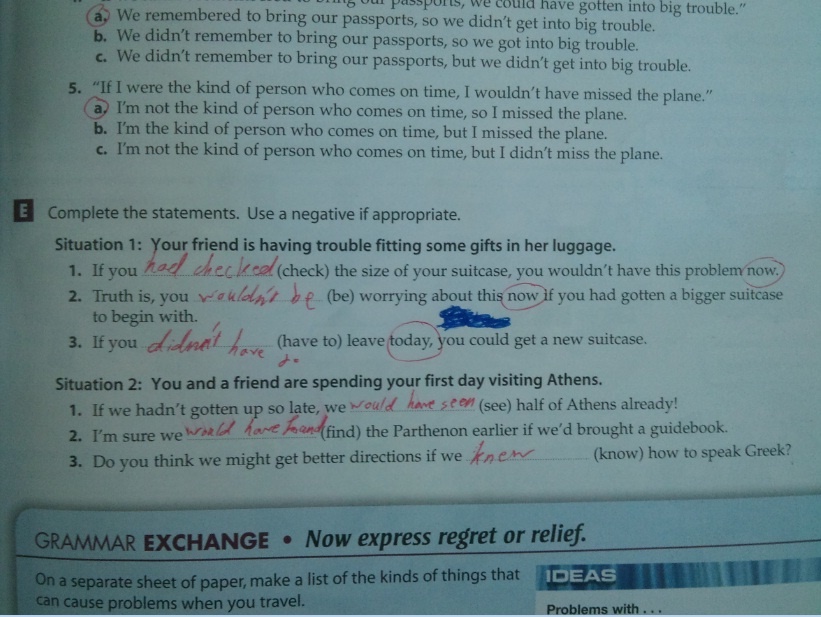
Source: Summit 2B (by Joan Saslo and Allen Ascher) Pearson
Longman Press, Unit6, Conditionals.
Thank you.
This exercise is written in my book;
E. Complete the sentences.
Situation 2: You and a friend are spending your first day visiting Athens.
3. Do you think we might get better directions if we .......... (know) how to speak Greek? (Answer key=Knew)
Why not "Know"? As you know, "might" can be used in both conditional I and Conditional II. Then it's really difficult to recognize whether "might" refers to which one.
I have taken a picture of the page.
If you click here, you will see it.
Source: Summit 2B (by Joan Saslo and Allen Ascher) Pearson
Longman Press, Unit6, Conditionals.
Thank you.
Top answer
Hello sb; Welcome to English Forums. Do you think we might get better directions if we .... knew .....
- Hello sb; Welcome to English Forums.
- Do you think we might get better directions if we ....
- knew .....
- (know) how to speak Greek?
- The friends do not speak Greek.
Get the Weekly English Kit 📬
New words, one handy idiom, and a 2-minute quiz — delivered to your inbox to keep your streak alive.
53 Answers
0
Hello sb;
Welcome to English Forums.
Do you think we might get better directions if we ....knew..... (know) how to speak Greek?
The friends do not speak Greek. Otherwise, they would not have to pose the question that way.
Thus, it is a hypothetical (untrue) condition, and the sentence follows the pattern of the conditional.
Welcome to English Forums.
Do you think we might get better directions if we ....knew..... (know) how to speak Greek?
The friends do not speak Greek. Otherwise, they would not have to pose the question that way.
Thus, it is a hypothetical (untrue) condition, and the sentence follows the pattern of the conditional.
 0
00
This is a second conditional because it is impossible or improbable and the timeframe is at the present. You are already in Athens and you and your friend know that you don't know how to speak Greek, and will not learn it that quickly. The tense used in second conditional construction is past, hence, "knew."
00
"If we know how to speak Greek" can either indicate a present ability (= given the fact that we know how to speak Greek) or be part of a "zero" conditional statement (If we know how to speak Greek, it's easier to communicate with native speakers of the language.).
00
ozzourti"If we know how to speak Greek" can either indicate a present ability (= given the fact that we know how to speak Greek) or be part of a "zero" conditional statement (If we know how to speak Greek, it's easier to communicate with native speakers of the language.).In my opinion no you can't. Perhaps if you were referring to someone else and there is t
00
0
KJinCali79In my opinion no you can't.Sorry, but I can't what?
KJinCali79 Perhaps if you were referring to someone else and there is the possibility that they speak Greek, but you are unsure. Otherwise, when speaking of your own ability you know whether or not you speak Greek, in which case there is no use for "if" in this example.
00
ITS A REMOTE CONDITION ITS A SECOND CONDITION IT CALLS FOR PAST SIMPLE
00
0
AnonymousHi can we use mixed conditional and use had knownYes.
If Tom had known how to change a light bulb, he wouldn't be sitting there in the dark.
00
hi can we say we might get better directions if we had known how to speak greek? if yes why and if no why
please answer i really need your help
please answer i really need your help
0 Related Questions