
W
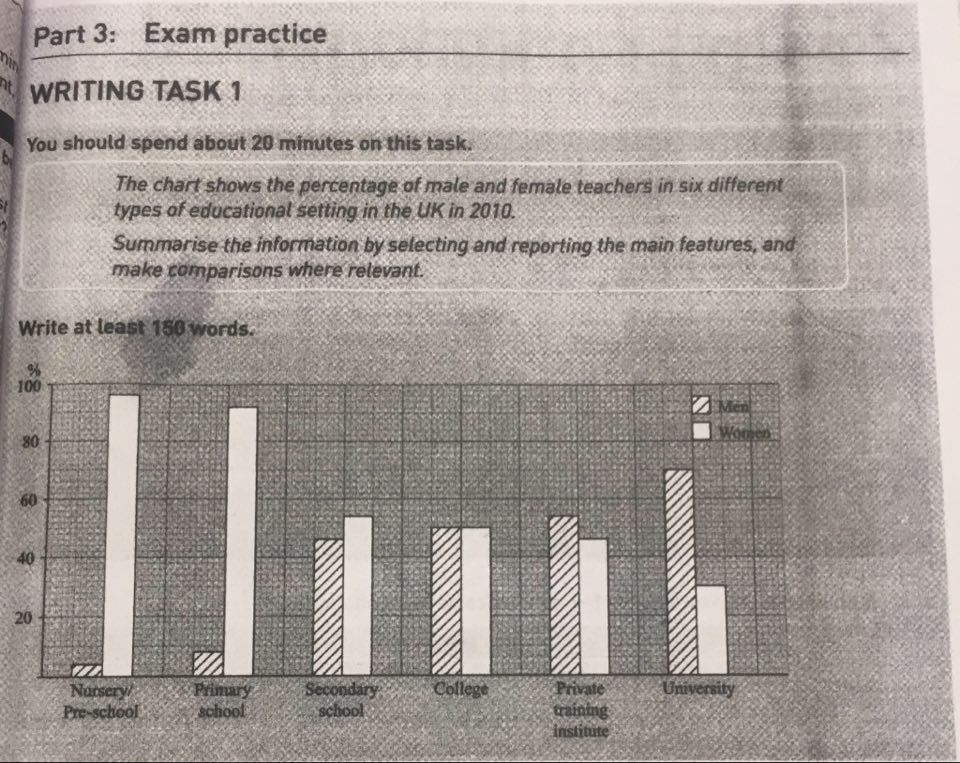
The graph gives information about the proportion of male and female teachers in six varying kinds of educational institutions in the UK in 2010.
Women held a particularly larger share of teaching for young children. While teaching for older children and young adults were gradually predominated by men.
Teaching at pre-school was women-dominated. Over 95 percent of women working in nursery schools, meanwhile men only made up nearly 5 percent. That was similarly one-sided in teaching at primary school. For example, women outnumbered men [nearly 95 percent], men were roughly 10 percent.
The range of educational setting from secondary school to private training institutions was equal gender distribution. Men were represented 50% averagely, either were women. Teaching at university for young adults was predominated by men, where there were over twice as many male lecturers as female lectures.
Top answer
Hu? Lê The graph gives information about the proportion of male and female teachers in six varying kinds of educational institutions in the UK in 2010. This figure is not called a graph.
- Hu?
- Lê The graph gives information about the proportion of male and female teachers in six varying kinds of educational institutions in the UK in 2010.
- This figure is not called a graph.
- Read the Task 1 instructions.
- If you use the wrong words for diagrams, figures, maps or tables, you will lose points.
Get the Weekly English Kit 📬
New words, one handy idiom, and a 2-minute quiz — delivered to your inbox to keep your streak alive.
Hu? LêThe graph gives information about the proportion of male and female teachers in six varying kinds of educational institutions in the UK in 2010.
This figure is not called a graph. Read the Task 1 instructions.
If you use the wrong words for diagrams, figures, maps or tables, you will lose points.
 0
0You wrote less than the minimum of 150 words. You will lose points for "Task Completion." In your practice essays, pay close attention to your word count. It is a very silly and avoidable mistake to write less than the minimum.
The graph gives information about the proportion of male and female teachers in six varying kinds of educational institutions in the UK in 2010.
0 Related Questions