
The diagrams below show the development of the horse over a period of 40 million years.
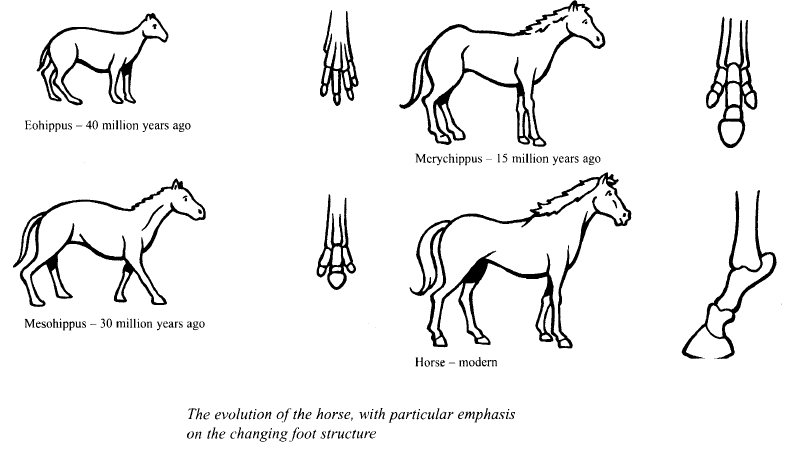
The picture illustrates the evolution of the horse after 40 million years.
Overall, the horse has had a significant changes in its size and the bone structure of its foot.
Eohippus, which appeared as the first one to be born in the lineage of the horse, had a 4-toe foot structure. Its size looked like a baby horse in comparison to the current modern ones. In addition, it has no fur on the back of the neck at all. 10 million years later, the eohippus has increased its size and had some light fur on its neck in order to become the Mesohippus. The two middle foot turned into one and had a bigger size than the two others.
Merychippus existed 15 million years ago, with a dramatic growth in body and foot size. The Merychippus has a notably emerged mane and also a longer tail than the two former horses. Until now, the modern horse has evolved into its largest size and all the foot has combined into one with an enlarged size. The mane and the tail all appear more conspicuously.
Top answer
The picture illustrates the evolution of the horse after (wrong preposition) over the past 40 million years. Four significant stages of development, ancestral species, are shown. ) significant changes in its size and the bone structure of its foot.
- The picture illustrates the evolution of the horse after (wrong preposition) over the past 40 million years.
- Four significant stages of development, ancestral species, are shown.
- ) significant changes in its size and the bone structure of its foot.
- Overall, today's horse is much larger than its distant ancestors.
- The bone structure of its foot has changed markedly.
Get the Weekly English Kit 📬
New words, one handy idiom, and a 2-minute quiz — delivered to your inbox to keep your streak alive.
The picture illustrates the evolution of the horse after (wrong preposition) over the past 40 million years. Four significant stages of development, ancestral species, are shown.
Overall, the horse has had a (Do not use "a" with a plura
 0
0 Related Questions