
TASK 1_FUEL EXPENDITURE
The first-semester examination is coming near, so I will try to practice more on writing. Could you please have a look at this writing? I would be grateful if you could help me improve it. Thank you very much.
.
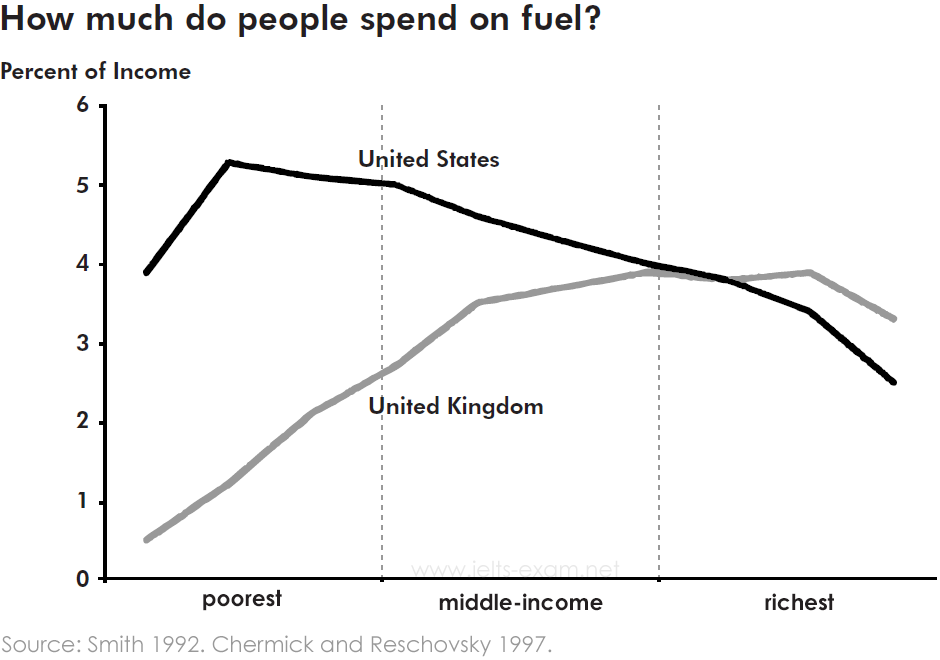
The line graph compares the percentage of income spent on the fuel of people in the United States and the United Kingdom, broken into three classes: the poorest, the middle-income, and the richest.
Overall, in the United Kingdom, the higher the income is, the more percentage of money is spent on fuel; however, it is not the case for the United States, where the proportion of money used on this product among the richest is lower than that of the poorest. There is a small group of people within the highest income bracket having a nearly identical proportion of earnings spent on fuel, approximately 4 percent.
The lowest fuel expenditure in the United Kingdom shown in the graph was about 0.5 percent, while in the United States, it was eightfold higher, nearly 4 percent. Also in the United States, it was among the poorest that the highest percentage of income spent on fuel was recorded, above 5 percent. As far as the middle-income bracket was concerned, fuel expenditure in the United Kingdom went upwards in accordance with the increase of earnings, while in the United States it was downwards. It continued to go down even when reaching the richest group, ending the line graph with about 2 percent.
Top answer
The line graph compares the percentage of income spent on the fuel of by people in the United States and the United Kingdom, as a function of annual income . (The X-axis is continuous and obviously the annual income. The Y-axis shows the percent of that income spent on fuel.
- The line graph compares the percentage of income spent on the fuel of by people in the United States and the United Kingdom, as a function of annual income .
- (The X-axis is continuous and obviously the annual income.
- The Y-axis shows the percent of that income spent on fuel.
- ) The income level is divided broken into three ranges classes : the poorest, the middle-income, and the richest.
- ) is spent on fuel; however, it is not the case for the United States, where the opposite is true; where the proportion of money used on this product among the richest is lower than that of the poorest.
Get the Weekly English Kit 📬
New words, one handy idiom, and a 2-minute quiz — delivered to your inbox to keep your streak alive.
The line graph compares the percentage of income spent on the fuel of by people in the United States and the United Kingdom, as a function of annual income. (The X-axis is continuous and obviously the annual income. The Y-axis shows the percent of that income spent on fuel. So the lin
 0
0 Related Questions