
Task 1 TEST 8
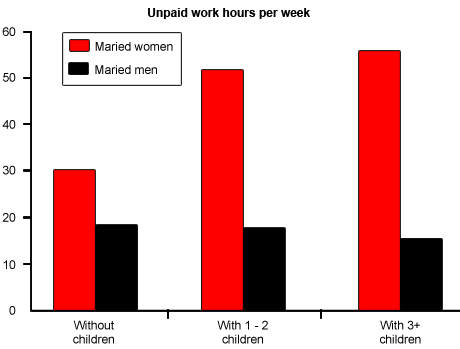
The diagram below shows the average hours of unpaid work per week done by people in different categories. (Unpaid work refers to such activities as childcare in the home, housework, and gardening.)
The bar chart compares the discrepancy between a married woman and a married man regarding the number of average weekly hours in unpaid work.
Overall, a high percentage of women were involved in unpaid work while the participation of men was significantly lower in all different structure families.
When it comes to the family with no children, approximately 30 hours per week women involved in unpaid work was spent, twice more than that for their opposite counterparts, a considerably lower than 18 hours. Regarding women with 1 or 2 children, the inequality becomes even more pronounced. While the average of unpaid work hours such as childcare or household chores for men remained stagnant, the number of hours women are reported to work increased rapidly to 52 hours.
More interestingly, moving on to the family of 3 children, men’s contributors to these unpaid jobs were less than that before the third child was given birth. The average women’s unpaid working hours rose to 58 hours per week compared to 16 hours from their husbands.
Top answer
The bar chart compares the discrepancy (not good) between a married woman and a married man regarding the number of average weekly hours in unpaid work. (Your description is woefully lacking. ) Overall, a high percentage of women were involved in unpaid work while the participation of men was significantly lower in all different structure familie s.
- The bar chart compares the discrepancy (not good) between a married woman and a married man regarding the number of average weekly hours in unpaid work.
- (Your description is woefully lacking.
- ) Overall, a high percentage of women were involved in unpaid work while the participation of men was significantly lower in all different structure familie s.
- (The reader is confused.
- ) When it comes to the family with no children, approximately 30 hours per week women involved in unpaid work was spent , (ungrammatical) twice more than that for their opposite counterparts, a considerably lower (ungrammatical.
Get the Weekly English Kit 📬
New words, one handy idiom, and a 2-minute quiz — delivered to your inbox to keep your streak alive.
The bar chart compares the discrepancy (not good) between a married woman and a married man regarding the number of average weekly hours in unpaid work. (Your description is woefully lacking. You did not mention the number of children, which is the most important variable on the chart!)
Overall, a high percentage of women
 0
0Sample Essay
The bar chart compares the number of hours that married men and women spend weekly on household chores and child care, as a function of family size. Three family sizes are shown: no children, one or two children and three or more.
Overall, women contribute many more hours than men, and the gap grows with family size. Regardless of the number of children, the men w
0 Related Questions