
TASK 1 (Table) Predictions regarding the change in percentage of the population
Hello teacher. This is an essay for task 1 in the IELTS test that I just wrote. Please check this essay for me.
Thank you so much.
Answer:
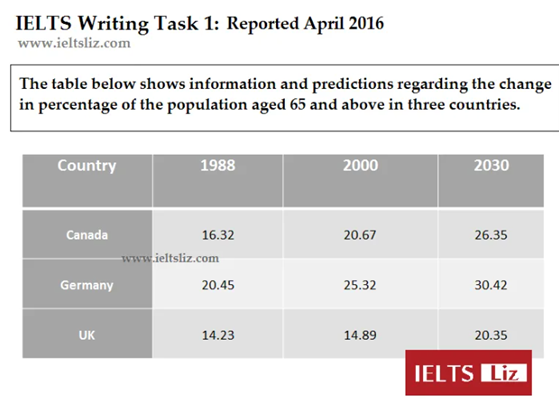
The table gives the proportion of the population who are equal or over 65 years old in three specific countries (Canada, Germany, and the UK) in 1988, 2000, and an estimated percentage in the year 2030.
Overall, the elderly people in these three countries raised from 1998 to 2000, and is predicted to continue its trend until 2030. Germany dominated the highest percentage of old people, and will remain the top-ranked in 2030. In contrast, the UK had the least proportion over the period given.
Between 1988 and 2000, there was a rise of approximately 5 percentage in both Canada (from about 16 to 21 percent) and Germany (from about 20 to 25 percent). The UK, on the other hand, showed an insignificant change in proportion (about less than 1 percent) and remained at slightly under 15 percent in both years.
By 2030, it is expected that the population aged 65 and over will rise by around 5.5 percent in all three countries, reaching the percentage of 26.35 in Canada, 30.42 in Germany, and 20.35 in the UK.
Top answer
The table gives the proportion of the population who are equal to or over 65 years old in three specific countries (Canada, Germany, and the UK) in 1988, 2000, and an estimate for d percentage in the year 2030. (Note: estimate can be either a verb or a noun. ) Overall, the elderly people (Wrong expression.
- The table gives the proportion of the population who are equal to or over 65 years old in three specific countries (Canada, Germany, and the UK) in 1988, 2000, and an estimate for d percentage in the year 2030.
- (Note: estimate can be either a verb or a noun.
- ) Overall, the elderly people (Wrong expression.
- People aged 65 are not considered "elderly" these days.
- ) ) in these three countries raised (wrong word.
Get the Weekly English Kit 📬
New words, one handy idiom, and a 2-minute quiz — delivered to your inbox to keep your streak alive.
The table gives the proportion of the population who are equal to or over 65 years old in three specific countries (Canada, Germany, and the UK) in 1988, 2000, and an estimate for d percentage in the year 2030. (Note: estimate can be either a verb or a noun. Using the noun form allows you to avo
 0
0 Related Questions