
Task 1, please help me review.
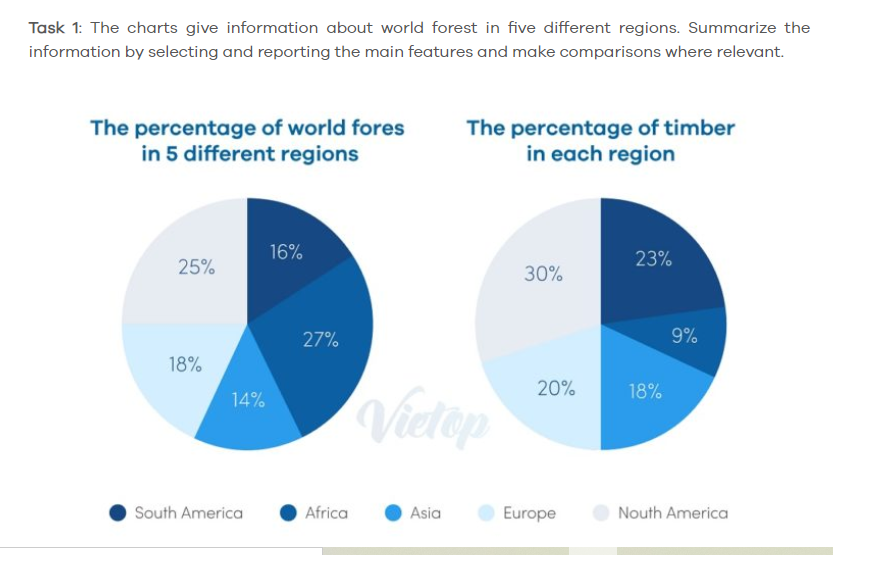
The two pie charts compare the proportion of the forest and timber in five different sectors, South America, Africa, Asia, Europe and North America.
Overall, although Africa is the region having the largest forest area in the world, it is the only one which accounts for the least in the amount of timber. Notably, a clear majority was recorded in the percentage of timber in North America.
In the first chart, the Africa region ranks first, with 27%, followed by North America, at 25%, was a little lower than that of Africa. However, for timber, North America has the greatest percentage of them compared to the others, with 30%, over three times higher than that of Africa, with only 9%.
Besides, a striking feature is that although South America stands at the fourth place for the forest areas in the world for a whole, it surpasses the remaining regions, with 23% of timber, only behind North America. For the other sectors, Europe is the third-largest one in each category, at18% and 20% respectively, whereas a minority describes the percentage of world forest and timber in Asia, at 14% and 18% respectively.
Top answer
The two pie charts compare the proportion of the forest and timber in five different sectors, regions of the world: South America, Africa, Asia, Europe and North America in terms of the ir percentage of the world’s forest area as well as the timber production in those regions . Overall, although Africa is the region having the largest forest area in the world, it is the only one which a ccounts for the least in the a mount of timber production . Notably, the clear majority was recorded in leader as far as the percentage of global timber production is in North America.
- The two pie charts compare the proportion of the forest and timber in five different sectors, regions of the world: South America, Africa, Asia, Europe and North America in terms of the ir percentage of the world’s forest area as well as the timber production in those regions .
- Overall, although Africa is the region having the largest forest area in the world, it is the only one which a ccounts for the least in the a mount of timber production .
- Notably, the clear majority was recorded in leader as far as the percentage of global timber production is in North America.
- In the first chart, the Africa n region ranks first, with at 27%, followed by North America, at 25%, was a little lower than that of Africa.
- However, for timber, North America has the greatest percentage of them c ompared to the others, with 30% of all timber in the world coming from that region , over three times higher than that of Africa, with at only 9%.
Get the Weekly English Kit 📬
New words, one handy idiom, and a 2-minute quiz — delivered to your inbox to keep your streak alive.
The two pie charts compare the proportion of the forest and timber in five different sectors, regions of the world: South America, Africa, Asia, Europe and North America in terms of their percentage of
 0
0 Related Questions