
[task 1] Please check my writing. thank you so much
Please help me. I'm having an IELTS test next month.
The charts illustrate the number of people who were affected by four types of noise pollution in day and night in cities and rural areas in 2007.
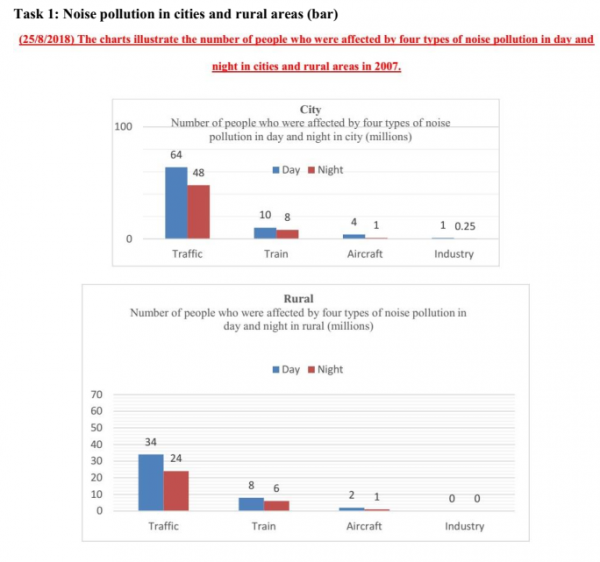
The bar charts compare how many people in urban and rural areas were influenced by four sources of noise pollution in day and night time. All data given was in 2007.
Overall, people in the cities affected by noise were more than those living in the countryside. Traffic is the main source of noise pollution.
The number of people affected by traffic noise in the daytime was 64 million in the city and 34 million in the countryside. At night, this value was 48 in the cities, which was double than that in the rural areas. In the daytime, the train noise affected 10 million urban people and 8 million residents in the countryside, which was slightly higher than the number people affected in the night in both areas, with 8 million and 6 million respectively.
The remaining sources affected urban and rural people was less significant. while aircraft noise influenced 4 million people in the urban, was twofold than the number of countryside people affected in the daytime. Meanwhile, in the nighttime, the value was the same in the cities and rural areas. In countryside, there was no one affected by noise from industrial activities as opposed to the number of urban residents experienced industrial noise was 1 million in the daytime and 0.25 million at night.
Top answer
The bar charts compare how many people in urban and rural areas were disturbed / bothered influenced by four sources of noise pollution in day and night time. ) All data given was in 2007. Overall, more people in the cities were affected by noise were more than those living in the countryside.
- The bar charts compare how many people in urban and rural areas were disturbed / bothered influenced by four sources of noise pollution in day and night time.
- ) All data given was in 2007.
- Overall, more people in the cities were affected by noise were more than those living in the countryside.
- Traffic is the main source of noise pollution.
- The number of people affected by traffic noise in the daytime was 64 million in the city and 34 million in the countryside.
Get the Weekly English Kit 📬
New words, one handy idiom, and a 2-minute quiz — delivered to your inbox to keep your streak alive.
The bar charts compare how many people in urban and rural areas were disturbed / bothered influenced by four sources of noise pollution in day and night time. (Incomplete - what are the sources?) All data given was in 2007.
Overall, more people in the cities
 0
0 Related Questions