
Table 1
The table shows forested land in millions of hectares in different parts of the world.
Summarise the information by selecting and reporting the main features, and make comparisons where relevant.
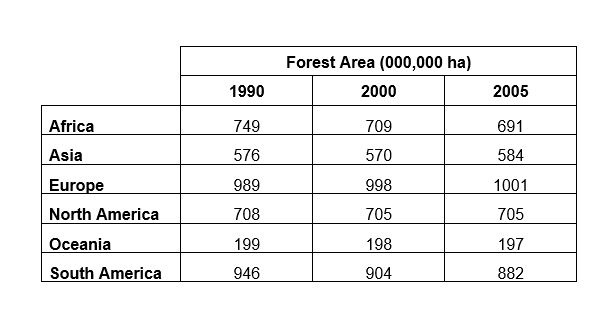
The table compares the amounts of forested areas in six regions of the world in the years 1990, 2000, and 2005.
Overall, there was a drop in the numbers of areas covered by forests, except for Europe and Asia. It is noticeable that Europe had more woodland than any other countries, while Oceania had the lowest figures for jungle areas.
Between 1990 and 2005, forest area in Europe rose from 989 million to 1001 million ha, having the highest figures for wood zones of all the parts shown. A rising trend was also seen in Asia, from 576 million to 584 million hectares in 2005. There was a slight decrease in the figures for North America, falling by 3 million from 708 million in 1990.
By contrast, South America, which had the third-highest number for wood regions in 1990, at 946 million, saw a significant drop to 882 million in 2005. The reduction of forested area could also be seen in Africa, standing at 691 million by 2005, after decreasing by nearly 60 million hectares.
Top answer
Please post essays, paragraphs, dialogues and other writing in the essay forum so a moderator does not have to move your post. Click on this link: Next, tap on the green button "write a new post"
- Please post essays, paragraphs, dialogues and other writing in the essay forum so a moderator does not have to move your post.
- Click on this link: Next, tap on the green button "write a new post"
Get the Weekly English Kit 📬
New words, one handy idiom, and a 2-minute quiz — delivered to your inbox to keep your streak alive.
 0
0Read my advice for vocabulary in Task 1 that is misused, like figure. Also "see, witness and experience" are often used wrongly.
0The table compares the amounts of forested areas in six regions of the world in the years 1990, 2000, and 2005. (What are the six regions?)
Overall, there was a drop in the numbers of areas (incorrect expression) covered by forests, except for Europe and Asia. It is noticeable that Europe had more woodlan
0 Related Questions