
0
MIG Posted 13 years ago
Grammar
Semi-modal verbs
Hi.
Please help me to find the complete list of Semi-modal verbs.
Is it even possible?
I want to gradually complete this info-graphic which is about auxiliary verbs.
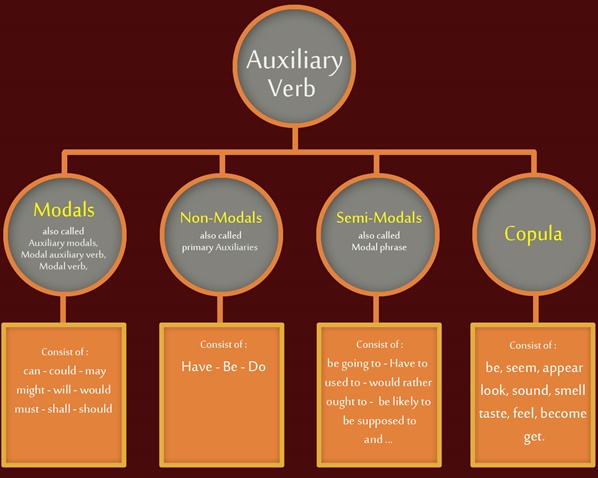
Please help me to find the complete list of Semi-modal verbs.
Is it even possible?
I want to gradually complete this info-graphic which is about auxiliary verbs.
Top answer
You are unlikely to find a completely satisfactory list if semi/quasi-auxiliary verbs, because there is little agreement on this.
- You are unlikely to find a completely satisfactory list if semi/quasi-auxiliary verbs, because there is little agreement on this.
Get the Weekly English Kit 📬
New words, one handy idiom, and a 2-minute quiz — delivered to your inbox to keep your streak alive.
9 Answers
0
You are unlikely to find a completely satisfactory list if semi/quasi-auxiliary verbs, because there is little agreement on this.
 0
00
Hi fivejedjon.
Right after when you answered this question,
fivejedjonYou are unlikely to find a completely satisfactory list if semi/quasi-auxiliary verbs, because there is little agreement on this.Ah, I knew it would be like that.
Right after when you answered this question,
00
I don't think there is a complete list of semi-modal verbs.
Here's another way of classifying auxiliary verbs:
Also, copulas are not universally recognized as auxiliaries. Neither are semi-modals.
Palmer lists only the following as semi-modals:
be bound to, be able to, have to, have got to, be going to, be willing to
He lists these as "margina
Here's another way of classifying auxiliary verbs:
Also, copulas are not universally recognized as auxiliaries. Neither are semi-modals.
Palmer lists only the following as semi-modals:
be bound to, be able to, have to, have got to, be going to, be willing to
He lists these as "margina
00
Thank you very much CalifJim and fivejedjon.
Please pardon me. I have one more question.
Would you please tell me y
Please pardon me. I have one more question.
Would you please tell me y
00
MIGCopula verbsThese are also called "linking verbs".
MIGyour opinionIn general I don't see linking verbs (copulas) as auxiliary verbs. That's my personal opinion. It's an opinion I get from traditional grammar.
The auxiliary be, however, can be used as a linking verb, so that's an exception. It's both a
00
0
I pretty much agree with CJ.
I differ only in that I don't like to label verbs as auxiliary, copular, lexical or other such terms, I think that, for example, BE, can function as a lexical verb (Be good. Bobby is being rather naughty today), a linking verb (John is happy/a teacher) or as an auxiliary verb (Fred was working
I differ only in that I don't like to label verbs as auxiliary, copular, lexical or other such terms, I think that, for example, BE, can function as a lexical verb (Be good. Bobby is being rather naughty today), a linking verb (John is happy/a teacher) or as an auxiliary verb (Fred was working
00
0
Having re-read CJ's post, I suspect that we don't differ at all in essentials.
0 Related Questions