
Please review my writing task 1.
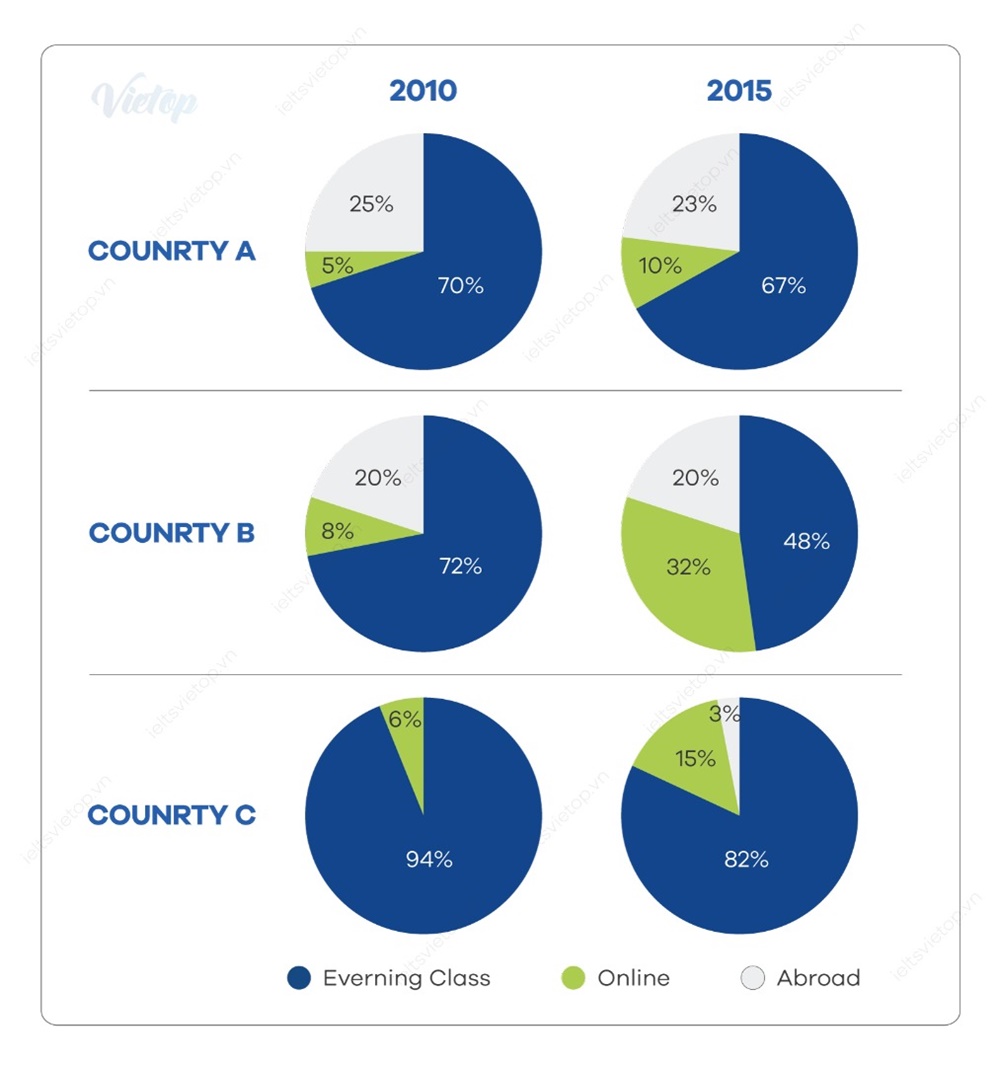
The charts below show how students in three countries choose to learn English in 2010 and 2015. Summarize the information by selecting and reporting the main features and make comparisons where relevant.
The pie charts compare the percentages of students learning English in three ways in countries A, B and C at two different points of time, 2010 and 2015.
Overall the highest proportion of people who learned their English was evening classes, despite a modest fall in three nations in the years 2010 and 2015. The rank order of the categories did not change in both years in two countries, except for the country B.
The percentages of individuals choosing in the evening classes in countries A and C was highest, about three-quarters and one in ten respectively of the total in 2010. The category in two countries also accounted for the greatest percentage, although there was an slightly decrease in each country by 3% and 12% in 2015. Two other modes of learning English changed with the percentage ranging 5-15% during the period shown.
In country B, the evening classes also made up the largest proportion at about 72%, while learning online English was the lowest in 2010. However, online learning surpassed abroad as the second category at about 32% in 2015, the percentage of learning abroad remained unchanged at 20% in both years.
Get the Weekly English Kit 📬
New words, one handy idiom, and a 2-minute quiz — delivered to your inbox to keep your streak alive.
 Related Questions