
Please review my writing!!!!
Question:
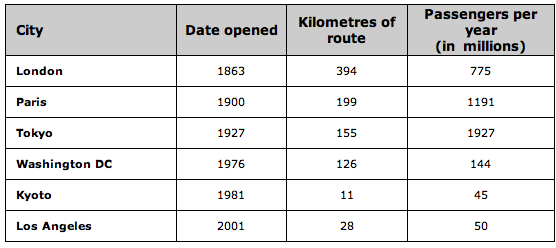
The table below gives information about the underground railway systems in six cities.
The table compares the underground railway networks in six metropolises regarding the opening date, the length of route, and the number of commuters per year.
Overall, it is evident that the three older rail systems in London, Paris, and Tokyo are larger and have more people traveling each year compared to those opened later in the remaining cities.
The underground railway system in London, which was introduced in 1863 and has 394 kilometers of route, comes first in terms of age and size. Opened in 1900, the Paris network is half as large as the London one. However, it carries 1191 million people annually, much higher than the figure of the oldest system. Despite ranking third in size, the Tokyo rail network is the most commonly used with 1927 passengers per year.
The railway system in Washington DC with 126 kilometers of route and 144 million passengers each year becomes the largest and busiest among the three younger systems. While the size of the newest network in Los Angeles doubled that of the Kyoto one, the number of commuters using these two systems is nearly the same, at 50 million and 45 million respectively.
Top answer
The table compares the underground railway networks in six metropolises regarding the opening date, in terms of their age, the track lengt h, of route, and the number of commuters per year. Overall, [ 1 ] it is evident that the three older rail systems in London, Paris, and Tokyo are larger have more extensive networks and have more people traveling each year compared to those opened later in the remaining cities. The underground railway system in London, which was introduced commissioned/built in 1863 and has 394 kilometers of route, comes first in terms of age and size.
- The table compares the underground railway networks in six metropolises regarding the opening date, in terms of their age, the track lengt h, of route, and the number of commuters per year.
- Overall, [ 1 ] it is evident that the three older rail systems in London, Paris, and Tokyo are larger have more extensive networks and have more people traveling each year compared to those opened later in the remaining cities.
- The underground railway system in London, which was introduced commissioned/built in 1863 and has 394 kilometers of route, comes first in terms of age and size.
- Opened in 1900, the Paris network is half as large as the Londo n’ s.
- one.
Get the Weekly English Kit 📬
New words, one handy idiom, and a 2-minute quiz — delivered to your inbox to keep your streak alive.
The table compares the underground railway networks in six metropolises regarding the opening date, in terms of their age, the track length, of route, and the number of commuters per year.
Overall, [ 1]
 0
0 Related Questions