
Please review my task 1 essay. Thank you teacher
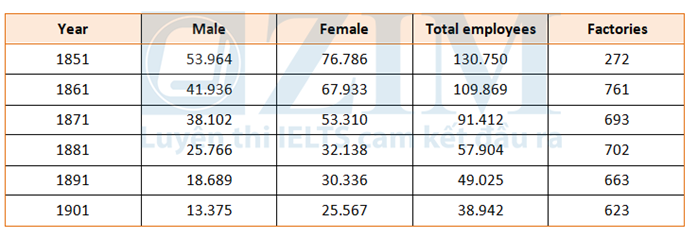
Topic: The table shows the number of employees and factories producing silk in England and Wales between 1851 and 1901.
My essay: The table demonstrates the workforce of silk-produced factories in both two countries England and Wales during a period from 1851 to 1901.
In general, there was a major decrease in terms of the total number of silk workers, and more women were employed than men. Additionally, an upward trend was observed for factories, despite some ups and downs.
In 1851, a total of 130.750 people in two nations worked in 272 silk factories, over half being female (76.786) compared to above 50.000 men. In next two decades, the number of employees declined steadily by a further 20.000 people whereas the factories almost tripled, reaching the peak at 761 despite also slight dipping to 693 in 1871. By 1881, there was a less positive trend for the number of total employees. Statistics continued to decrease regarding both female and male workers, falling from 32.138 and 25.766 to 25.576 and 13.375 respectively, which led to a drop in total number, at bottom level 38.942 in 1901. Similarly, factories also experienced a gradual decline from 702 to 623 although generally showing a threefold increase than before.
Top answer
The table demonstrates (wrong word. ) the workforce of silk-produced (wrong expression. ) factories in both two countries England and Wales during a period from 1851 to 1901.
- The table demonstrates (wrong word.
- ) the workforce of silk-produced (wrong expression.
- ) factories in both two countries England and Wales during a period from 1851 to 1901.
- (Incomplete.
- ) In general, there was a major decrease in terms of the total number of silk workers, and more women were employed than men.
Get the Weekly English Kit 📬
New words, one handy idiom, and a 2-minute quiz — delivered to your inbox to keep your streak alive.
The table demonstrates (wrong word. What is in the table?) the workforce of silk-produced (wrong expression. This means factories that were made of silk.) factories in both two countries England and Wales during a period from 1851 to 1901. (Incomplete. You did not mention men and wom
 0
0Sample Essay;
The table lists the number of people (male, female and total) employed in the silk industry in England and Wales every ten years between 1851 and 1901. In addition, it records the number of factories.
Overall, the total workforce was the largest in 1851, and it decreased steadily over each ten-year time span. The number of factories was the smallest i
0 Related Questions