
Please review my task 1
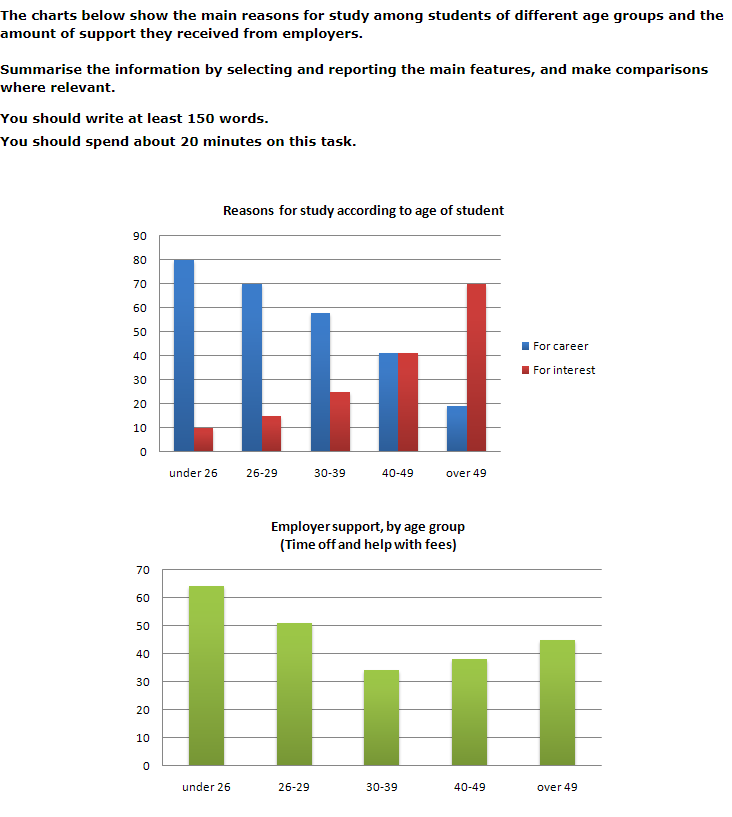
The two figures present why the pupils of many different age ranges choose to learn and the amount of assistance they got from their companies for their study.
Overall, students decided to study for their careers when they are young. However, this trend declines and is replaced by their interest as they get older. The amount of support they received also varies by their age groups.
The first chart shows that around 80% of the students under 26 want to prepare for their career by studying. However, over time, this reason starts to become irrelevant to the pupils as the percentage of students drop by 10% to 20% every period, resulting in under one-fifth of the students belong to this category. In constrast, only 10% of the students choose to study to fulfil their interests when they are under 26. This number increases drastically, reaching approximately 70% for the oldest segment. The group of 40 – 49 years old has the most balance number of over 40% for both reasons.
The second chart shows that students under the age of 26 receive the most help from the employeers, starting at approximately 62%. The amount of support begins to be decreased as they grow older, reaching its lowest of over 30% at the age of 30 – 39. After that, it increases slightly toward the older age group.
(I have read somewhere that if the number, say, decreases from 9 to 6, also means that it decreases by 50%. Will this also apply if it drops from 90% to 60%?)
Top answer
Le Minh Quang the pupils I cannot imaging pupils working for a living! All pupils are also students, but students can be any age.
- Le Minh Quang the pupils I cannot imaging pupils working for a living!
- All pupils are also students, but students can be any age.
Get the Weekly English Kit 📬
New words, one handy idiom, and a 2-minute quiz — delivered to your inbox to keep your streak alive.
 0
0Le Minh Quangas the percentage of students drop by 10% to 20% every period,
You have a completely wrong approach.
This is not a survey taken once per decade. There is not any time period. There is one survey at one point in time. The people in different age groups have answered the survey differently. You are comparing older people with younger peopl
0Le Minh Quang(I have read somewhere that if the number, say, decreases from 9 to 6, also means that it decreases by 50%. Will this also apply if it drops from 90% to 60%?)
No.
You have to do the calculation. It is quite simple.
You have to subtract the two numbers and then divide to get correct value for X in the phrase "increase / decrease
0 Related Questions