
Please, review my Task 1
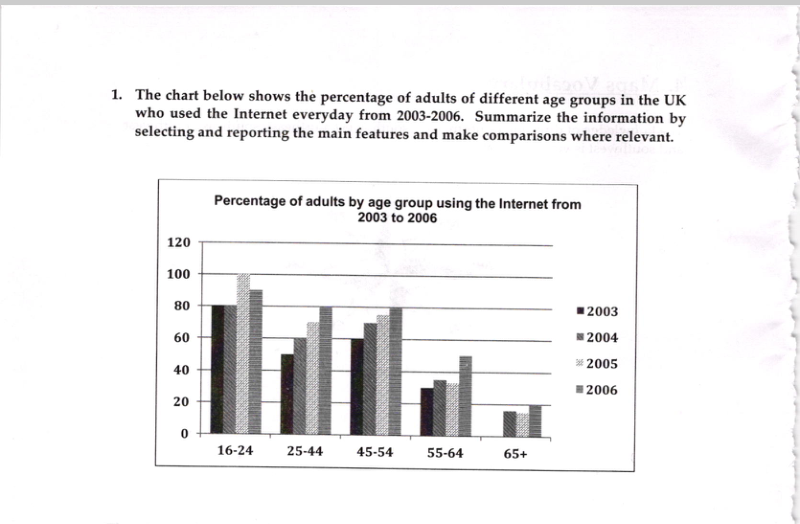
The bar chart compares the changes in the proportion of British adults of five age groups using the Internet on a daily basis between 2003 and 2006.
Overall, the highest majority of Internet users were 16-24 year olds and the percentages showed an increase in each age group towards the end of the time span.
Starting from the highest figures of daily Internet users,16-24 year olds made up 80% in 2003 and 2004 followed by the biggest growth of 100 % in the following year before dropping to a slight 90% in 2006. Similarly, 25-44 and 45-54 age profiles both gradually grew to 80% in 2006, the former rising from 50% and the latter from 60% at the beginning of the time period.
Looking at the older age group, it can be noticed that the trend to use the Internet on a daily basis was less popular among UK citizens. In 2003, about 30% of British people aged 55 to 64 used the Internet every day and figures rose to 50% in 2006. Meanwhile, the remaining category, people over 65+ of age had the lowest percentages ending the time period with a slight 20% increase.
Top answer
The bar chart compares the changes in the proportion of British adults of five age groups using the Internet on a daily basis in each year between 2003 and 2006. ) Overall, the highest percentage majority of Internet users were the 16-24 year olds as compared to all other age groups . For all the age groups, daily internet usage he percentages showed an tended to increase with time.
- The bar chart compares the changes in the proportion of British adults of five age groups using the Internet on a daily basis in each year between 2003 and 2006.
- ) Overall, the highest percentage majority of Internet users were the 16-24 year olds as compared to all other age groups .
- For all the age groups, daily internet usage he percentages showed an tended to increase with time.
- in each age group towards the end of the time span .
- Starting from the highest percent figures of daily Internet users,16-24 year olds made up 80% in 2003 and 2004 followed by the biggest growth of 100 % in the following year before dropping to a slight 90% in 2006.
Get the Weekly English Kit 📬
New words, one handy idiom, and a 2-minute quiz — delivered to your inbox to keep your streak alive.
The bar chart compares the changes in the proportion of British adults of five age groups using the Internet on a daily basis in each year between 2003 and 2006. (What are the age groups?)
Overall, the highest percentage majority of Internet users we
 0
0 Related Questions