
Please review my IELTS writing task 1, thanks
Topic: The diagrams below show how sand dunes are formed
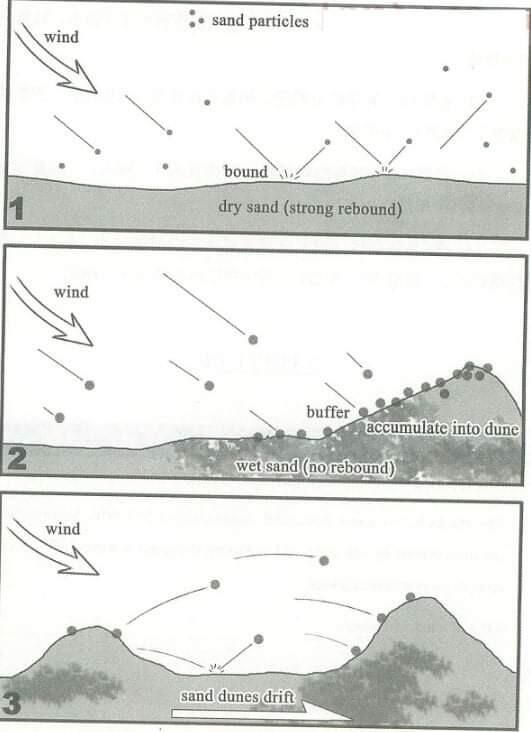
The diagrams illustrate the formation of sand dunes from wind-driven sand particles.
Overall, sand dunes are mounds of sand piled up by the wind. Their formation and drift are the result of interactions between winds and the ground.
In detail, sand dunes cannot form without wind and wet ground, as shown by the first figure. If the ground is dry, the sand particles carried in the wind will bounce off when they hit the ground and then be blown away. However, if the ground is wet, it can act as a buffer that absorbs the momentum of sand particles, which therefore settle on the surface and accumulate into dunes. They are shaped by the wind, as the slope against the wind is gentle, whereas the one sheltered from the wind is steep.
Sand dunes are not permenant, as the sand particles that form them can still be blown away. They drift to a new patch of wet ground through wind transport and amass into a new dune. As the new dune develops, the old one shrinks.
Top answer
The three diagrams illustrate the formation of sand dunes from wind-driven sand particles. Overall, sand dunes are mounds of sand piled up by the wind. Their formation and drift are the result of interactions between the prevailing winds and the ground.
- The three diagrams illustrate the formation of sand dunes from wind-driven sand particles.
- Overall, sand dunes are mounds of sand piled up by the wind.
- Their formation and drift are the result of interactions between the prevailing winds and the ground.
- In detail, sand dunes cannot form without wind and wet ground, as shown by the first two figures.
- If the ground is dry, the sand particles carried in the wind will bounce off when they hit the ground and then be blown away.
Get the Weekly English Kit 📬
New words, one handy idiom, and a 2-minute quiz — delivered to your inbox to keep your streak alive.
The three diagrams illustrate the formation of sand dunes from wind-driven sand particles.
Overall, sand dunes are mounds of sand piled up by the wind. Their formation and drift are the result of interactions between the prevailing winds and the ground.
In detail, sand dunes cannot form without wi
 0
0 Related Questions