
Please review my Ielts task 1 essay
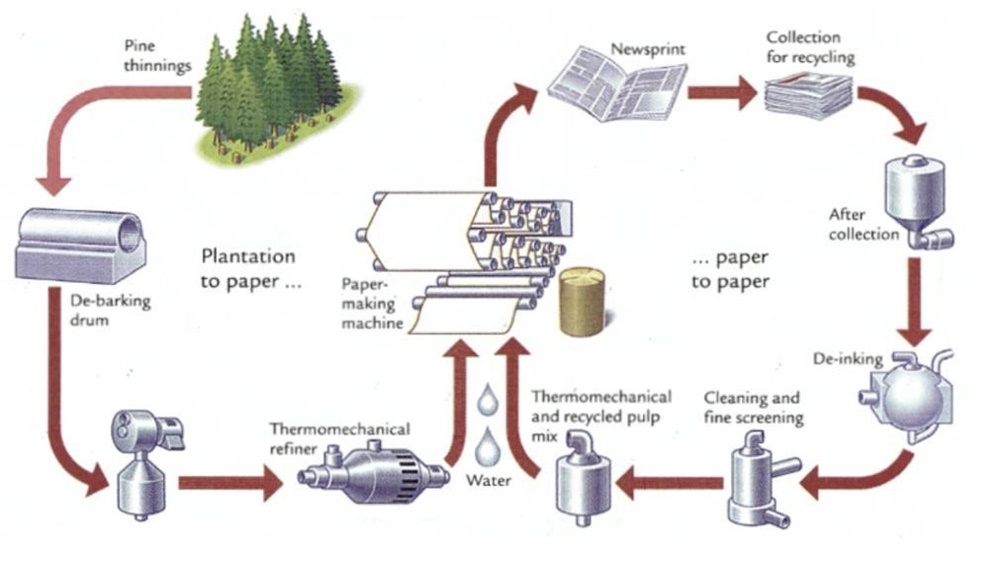
The diagram below shows how newspapers are produced and recycled.
Summarise the information by selecting and reporting the main features, and make comparisons where relevant.
My essay:
The flow chart illustrates the production and recycling of newspapers.
Overall, both processes are similar in that each is a largely mechanical process consisting of three main stages; preparing the raw ingredients, converting these into pulp, and manufacturing the newsprint.
The production of original newspapers starts with poor-quality pipe trees grown on farms being removed, collected and conveyed to a processing plant. In the second stage, the trees are debarked by a drummer. Next, the wood is put into a chipper, reducing them into smaller woodchips, which are converted into pulp by a thermomechanical refiner. The final stage begins with forming the pulp into paper, which is used to make newsprint.
To start the recycling process, discarded newspapers are gathered and transferred to a manufacturing center. What follows is the second stage, which turns the papers into pulp. At this point the pulp is contaminated with inks, so the next step is moving this undesired element from the pulp. The output is cleaned, fine screened and then mixed with thermomechanical pulp. Finally, they go into the third stage, which is the same as the production process.
Top answer
The flow chart diagram illustrates the production and recycling of newspapers. Overall, both processes are similar in that each is a largely mechanical process consisting of three main stages; preparing the raw ingredients, converting these into pulp, and manufacturing the finished paper. newsprint.
- The flow chart diagram illustrates the production and recycling of newspapers.
- Overall, both processes are similar in that each is a largely mechanical process consisting of three main stages; preparing the raw ingredients, converting these into pulp, and manufacturing the finished paper.
- newsprint.
- The production of original n ewspapers starts with [ 1 ] poor-quality pipe the cutting of pine trees grown on farms being removed, collected and conveyed taking them to a processing plant.
- In the second stage, the trees are debarked in a large drum.
Get the Weekly English Kit 📬
New words, one handy idiom, and a 2-minute quiz — delivered to your inbox to keep your streak alive.
The flow chart diagram illustrates the production and recycling of newspapers.
Overall, both processes are similar in that each is a largely mechanical process consisting of three main stages; preparing the raw ingredients, converting these into pulp, and manufacturing the finished paper.
 0
0 Related Questions