
Please Review My IELTS Task 1 Essay
The pie charts below show the average household expenditures in Japan and Malaysia in the year 2010.
Summarize the information by selecting and reporting the main features, and make comparisons where relevant.
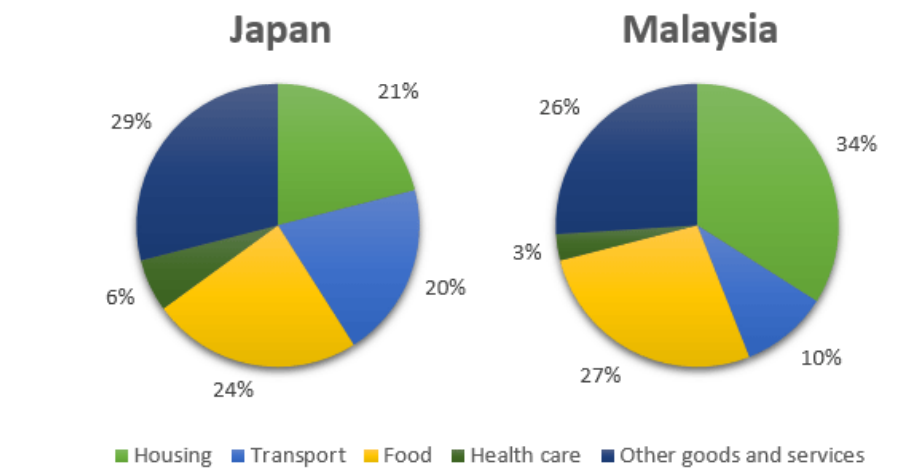
The charts give information about the average household spending, which took place in Japan and Malaysia, in 2010. Overall, household in both countries spent the lowest for health care shown. While housing accounted for the largest proportion in Malaysia, Japanese household spent the highest for other goods and services.
A mere 3% of expenditure in Malaysia is for health care, which was half the proportion in Japan (6%). Similarly, the percentage for transportation in Japan was 2 times as much as in Malaysia, 20% and 10% respectively.
In Malaysia, housing comprised more than one thirds of total spending, which is the highest proportion. However, Japanese household spent 21% for this group, being lower by about 10% than in Malaysia. In terms of other goods and services, Japanese household spent the largest for this category, which accounted for 29%. This percentage is less in Malaysia seen (26%). Expenditure on food in Malaysia was higher slightly than in Japan, 27 and 24% in order.
Top answer
Please read my advice for Task 1 essays: IELTS TASK 1: Hints, Tips And Advice Vocabulary Words For Task 1: Reference Post
- Please read my advice for Task 1 essays: IELTS TASK 1: Hints, Tips And Advice Vocabulary Words For Task 1: Reference Post
Get the Weekly English Kit 📬
New words, one handy idiom, and a 2-minute quiz — delivered to your inbox to keep your streak alive.
 0
0The (what kind of chart? Bar chart? Gantt chart? Flow chart?) charts give information about (That is vague. It does not tell the reader what is on the charts.) the average household spending, which took place in Japan and Malaysia, in 2010. (When you change the topic from the figure to its content, you have to start a n
0Sample essay
The two pie charts, one for Japan and the other for Malaysia, compare average household spending in 2010, broken down into five categories: housing, transport, food, health care, and other.
Overall, Malaysians spent a disproportionately large percentage of their money on food and housing compared to the Japanese. But the budget for transport expenses was twi
0 Related Questions