
Please review my IELTS Task 1 essay.
Topic:
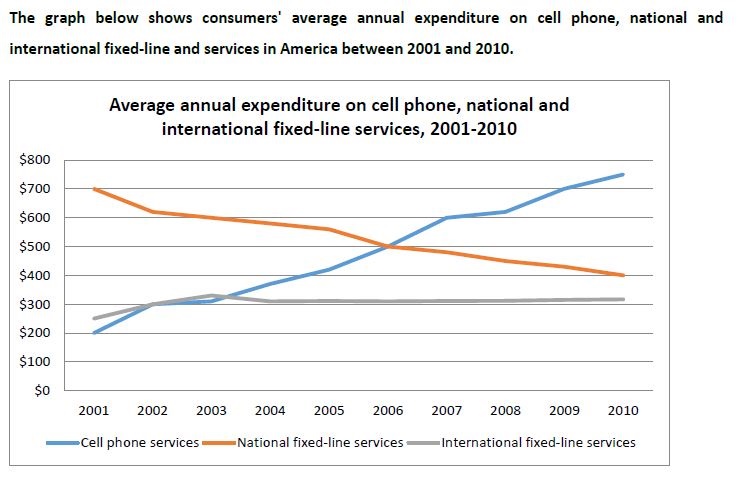
The graph below shows consumers' average annual expenditure on cell phone, national and international fixed-line and services in America between 2001 and 2010.
Summarise the information by selecting and reporting the main features, and make comparisons where relevant.
Thank you for your help!
My essay:
The line graph compares the average amount of money spent yearly on three different telecommunication networks in the US over a period 9 years starting from 2001.
It is clear that national fixed-line services were the main means of telecommunication in the first 5-year period, but mobile phone dominated for the rest of the period. The spending amount of international fixed-line services changed marginally for the whole period shown.
In 2001, national fixed-line services were by far the most important network, people in America spent about 700 dollars per year. The average amount of money paid for Cell-phone and international fixed-line services were just under 260 dollars each. By 2006, consumers charging for mobile phone overtook national fixed-line services.
Between 2001 and 2010, average annual expenditure on national fixed-line services dropped steadily by $300. By contrast, the figure for cell-phone services increased significantly and continually to roughly $750 in 2010. On other way, International fixed-line services witnessed a slight increase from $250 to $320 in the first 3-year period, and remained at the level of $300 for the rest of the period.
Top answer
The line graph compares the average amount of money spent yearly on three different telecommunication networks (wrong word. Consumers do not by communication networks. ) in the US over a period 9 years starting from 2001.
- The line graph compares the average amount of money spent yearly on three different telecommunication networks (wrong word.
- Consumers do not by communication networks.
- ) in the US over a period 9 years starting from 2001.
- It is clear that (These words: clear, obvious, evident, noteworthy, and apparent are opinion words.
- Do not write opinions in Task 1.
Get the Weekly English Kit 📬
New words, one handy idiom, and a 2-minute quiz — delivered to your inbox to keep your streak alive.
The line graph compares the average amount of money spent yearly on three different telecommunication networks (wrong word. Consumers do not by communication networks. Major companies do, though.) in the US over a period 9 years starting from 2001.
It is clear that (These words: clear, obvious, evident, noteworthy, and a
 0
0 Related Questions