
Please review my IELTS task 1
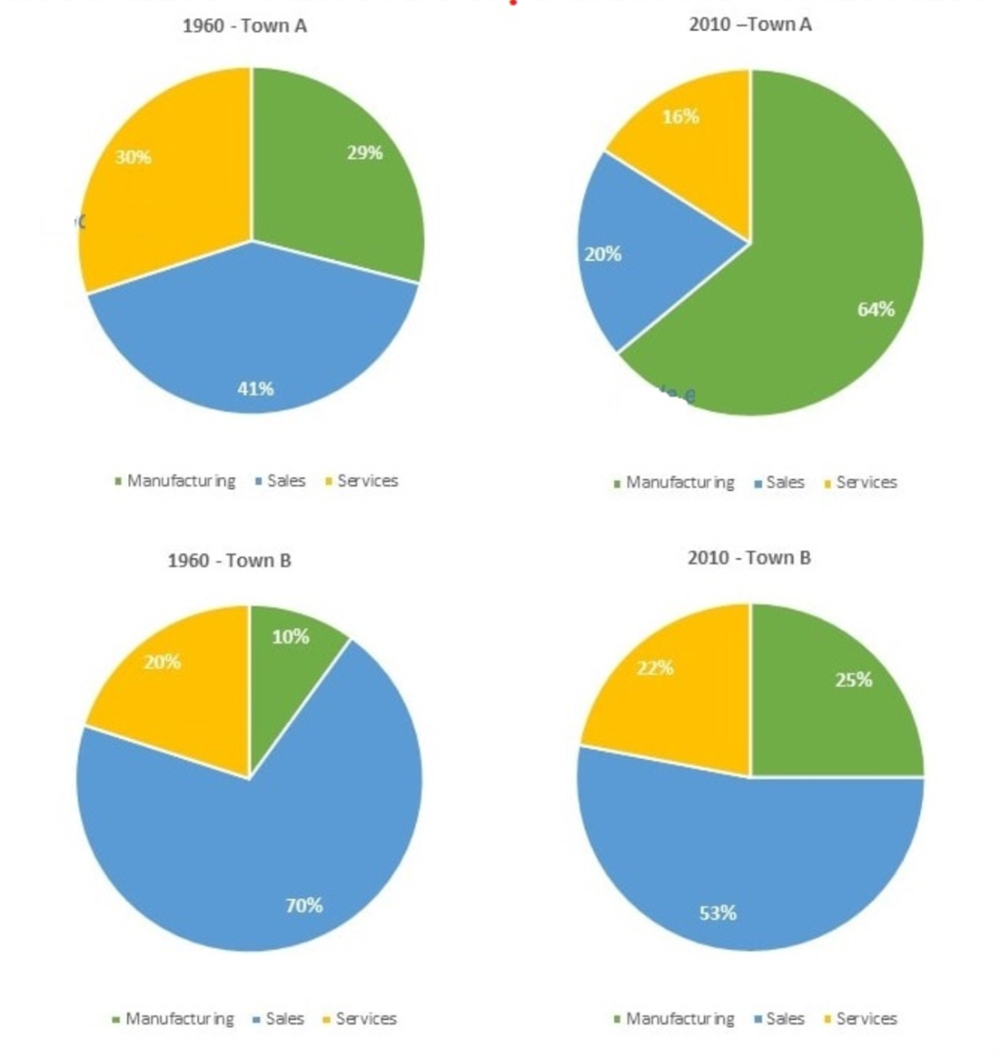
The charts show the percentage of people working in different sectors in town A and B in the two years 1960 and 2010. Summarise the information by selecting and reporting the main features and making comparisons where relevant.
The pie charts compare the distribution of employment in town A and town B between 1960 and 2010.
Overall, it is clear that employees in town A had a tendency to work in the manufacturing sector, meanwhile, sales positions became a popular trend in town B.
Regarding town A, in 1960, the percentage of workers in the sales sector and service sector accounted for 41% and 30%, respectively. After 50 years, these figures dramatically decreased by half. In contrast, the proportion of manufacturing workers showed an upward trend, which increased significantly from 29% in 1960 to 64% in 2010.
In town B, the proportion of sales workers still remained as the highest number over the period and experienced a sharp decline from 70% in 1960 to 53% in 2010. In contrast, the percentage of those who work in manufacturing increased significantly from one-tenth to a quarter over a 50-year period. There was a slight growth in the figure of service workers by 2%.
Top answer
Please read my advice for Task 1 essays: IELTS TASK 1: Hints, Tips And Advice Vocabulary Words For Task 1: Reference Post
- Please read my advice for Task 1 essays: IELTS TASK 1: Hints, Tips And Advice Vocabulary Words For Task 1: Reference Post
Get the Weekly English Kit 📬
New words, one handy idiom, and a 2-minute quiz — delivered to your inbox to keep your streak alive.
 0
0The (How many of them?) pie charts compare the distribution of employment (Not a good description ) in town A and town B between 1960 and 2010. (Not good. "Between" is for line graphs and bar charts with continuous data. This has only two points in time. You did not tell the reader wh
0Sample essay:
The four pie charts, two for Town A and two for Town B, give a breakdown of their employment among three sectors of the economy (manufacturing, sales and services) in 1960 and 2010.
Overall, the charts show major changes to the patterns of employment in both towns. In Town A in 1960 there was no dominant sector, although sales was the largest. In the other three cha
0 Related Questions