
Please review my IELTS essay (Process)
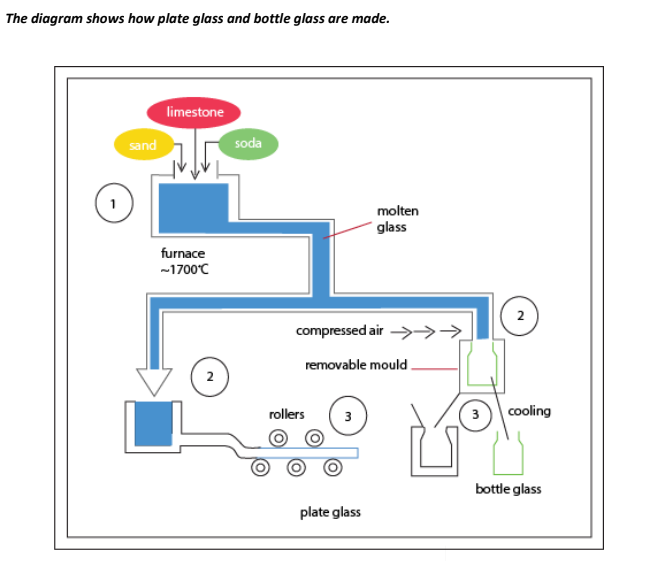
The drawing illustrates the production of plate glass and bottle glass.
In general, both plate glass and bottle glass undergo three stages to be made, including the same first stage.
At the initial stage, a mixture of raw materials consisting of sand, limestone and soda is poured into a furnace. It is heated by the temperature at 1700 degree Celsius until it becomes molten glass. The hot liquid glass subsequently flows through a pipe to a tank, which has a valve attached. When this valve is open, molten glass flows through rollers, which are responsible for flattening glass out. Consequently, plate glass is created.
When it comes to bottle glass, molten glass is pumped into a mould instead of a tank in the process of making plate glass. Air is spontaneously pumped into this mould to compress glass as long as this mould is completely empty. After cooling process, this mould can be removed from bottle glass as can be seen from the diagram.
(164 words)
Top answer
) bottle glass. In general, both plate glass and bottle glass undergo three stages to be made. , including They share the same first stage.
- ) bottle glass.
- In general, both plate glass and bottle glass undergo three stages to be made.
- , including They share the same first stage.
- At the initial stage, a mixture of raw materials consisting of sand, limestone and soda is poured into a furnace.
- It is heated by the furnace up to a (We do not heat by temperature.
Get the Weekly English Kit 📬
New words, one handy idiom, and a 2-minute quiz — delivered to your inbox to keep your streak alive.
The drawing illustrates the production of plate glass and (Wrong word order.) bottle glass.
In general, both plate glass and bottle glass undergo three stages to be made. , including They share the same first stage.
At the initia
 0
0 Related Questions