
Please review my IELTS essay
My essay:
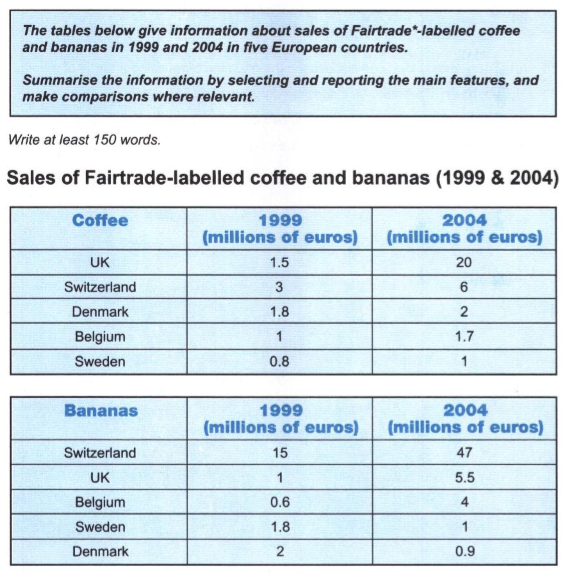
The two tables compare five different nations in terms of the amount of money spent on fairtrade coffee and bananas in two separate years, 1999 and 2004.
Overall, sales of Fairtrade coffee increased in all five countries, while there was mixed success for similarly labelled bananas, and the leading country in each table had significantly higher sales than the rest.
In 1999, Switzerland had the highest sales of both Fairtrade coffee and bananas, with figures being €3 million and €15 million, respectively. By 2004, however, the money spent on coffee in the UK increased more than tenfold to a whopping €20 million, three times higher than the equivalent amount in Switzerland (€6 million). Meanwhile, Switzerland still spent far more money on bananas than the other countries, exceeding that of the UK by €41.1 million, €47 against €5.5 million.
Sales of the two commodities were generally far lower in Denmark, Belgium and Sweden, remaining at €2 million or below, except for banana sales in Belgium in 2004, at €4 million. Moreover, the only decreases in sales were seen in Sweden and Denmark, where the money spent on bananas approximately halved, from €1.8 to €1 million and from €2 to €0.9 million, respectively.
Top answer
The two tables compare five different nations in terms of the amount of money spent on fairtrade coffee and bananas in two separate years, 1999 and 2004. Overall, sales of Fairtrade coffee increased in all five countries, while there was mixed success for similarly labelled bananas, and the leading country in each table had significantly higher sales than the rest. In 1999, Switzerland had the highest sales of both Fairtrade coffee and bananas, with figures being €3 million and €15 million, respectively.
- The two tables compare five different nations in terms of the amount of money spent on fairtrade coffee and bananas in two separate years, 1999 and 2004.
- Overall, sales of Fairtrade coffee increased in all five countries, while there was mixed success for similarly labelled bananas, and the leading country in each table had significantly higher sales than the rest.
- In 1999, Switzerland had the highest sales of both Fairtrade coffee and bananas, with figures being €3 million and €15 million, respectively.
- By 2004, however, the money spent on coffee in the UK increased more than tenfold to a whopping (Do not use this type of descriptive word in Task 1.
- ) €20 million, three times higher than the equivalent amount in Switzerland (€6 million).
Get the Weekly English Kit 📬
New words, one handy idiom, and a 2-minute quiz — delivered to your inbox to keep your streak alive.
The two tables compare five different nations in terms of the amount of money spent on fairtrade coffee and bananas in two separate years, 1999 and 2004.
Overall, sales of Fairtrade coffee increased in all five countries, while there was mixed success for similarly labelled bananas, and the leading country in each table had significantly higher sales than the rest.
In 1999, Switzer
 0
0 Related Questions