
Please review my IELTS essay
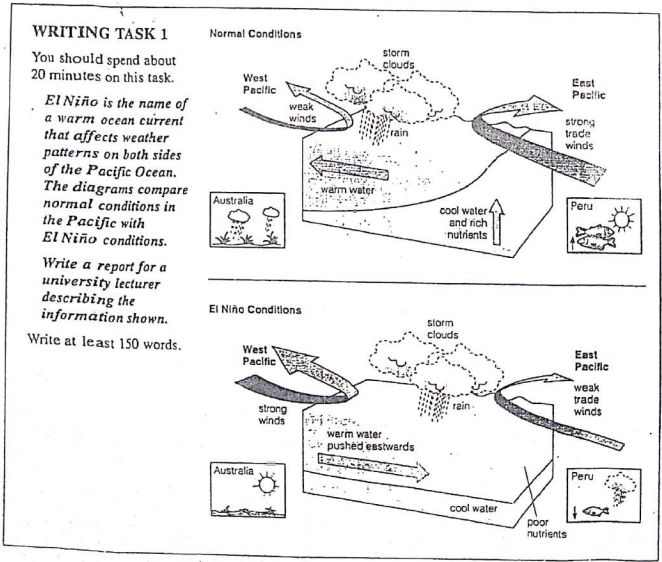
The two schematic diagrams depict normal conditions and El Nino conditions in the Pacific.
Overall, El Nino is the scientific term of a warm ocean current affecting climatic patterns on both sides of the Pacific Ocean. In particular, the power of winds on two sides, the flow of warm water, the water conditions, and the weather in Australia and Peru are all affected.
In detail, in normal conditions, the Pacific has week westerlies and strong easterlies. Rain is concentrated in the western Pacific, resulting in the rainy season in Australia and sunny days in Peru. Also, warm water flows to the west, which leads to the concentration of cool water and rich nutrients in the eastern Pacific.
Nonetheless, the weather patterns of the Pacific Ocean when impacted by El Nino reverse. The westerlies are strong when the converse is true for easterlies. Precipitation in the east of the Pacific is higher than in the west, which contributes to the rainy days in Peru and weltering days in Australia. Such weather patterns also lead to a decrease in the number of fish in Peru and that of plants in Australia. Furthermore, warm water is pushed eastwards; that is, cool water is distributed evenly, and poor nutrients concentrate in the east.
Get the Weekly English Kit 📬
New words, one handy idiom, and a 2-minute quiz — delivered to your inbox to keep your streak alive.
 Related Questions