
Please review my bar chart essay
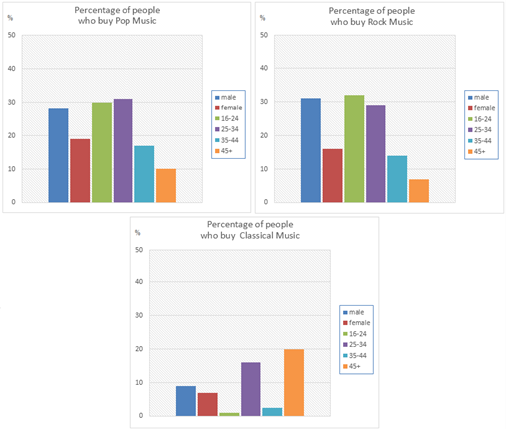
Topic: The graphs below show the types of music albums purchased by people in Britain according to sex and age.
My essay:
The three bar charts compare three different kinds of music albums, namely pop, music and classical in terms of the percentage of purchasers based on sex and age.
Overall, male bought more music albums than female regardless of kinds. Additionally, while teenagers and adults aged 25-34 were favored pop and rock albums, classical ones were the most common among elder people aging over 45.
The gender gap was shown for buyers of pop and rock, as a third or more of men spent money, which was nearly twofold as much as that of their peer-group (roughly 17%). In contrast, there was not much difference in proportion of purchasers’ classical music, both sexes spent between 8% and 9%.
There was a similar percentage of age brackets in terms of pop and rock music, with approximately 30% of people aged from 16 to 34 allocating, followed by 35–44-year-old buyers (16%), while the eldest group accounted for a fifth or less of their budget. In contrast, the youngest and those aged 35-44 spent modestly for classical one. A remarkable expenditure on classical albums at the age of over 45 and 25-34, 20% and 18% respectively.
Top answer
The three bar charts compare three different kinds of music albums, namely pop, music and classical in terms of the percentage of their purchasers based on *** and age. (That does not make much sense. Your essay does not have coherence or cohesion because you did not give the age brackets in the first paragraph.
- The three bar charts compare three different kinds of music albums, namely pop, music and classical in terms of the percentage of their purchasers based on *** and age.
- (That does not make much sense.
- Your essay does not have coherence or cohesion because you did not give the age brackets in the first paragraph.
- ) regardless of kinds.
- Additionally, while teenagers (You have not mentioned any age brackets, but there is no "teenager" group on these charts.
Get the Weekly English Kit 📬
New words, one handy idiom, and a 2-minute quiz — delivered to your inbox to keep your streak alive.
The three bar charts compare three different kinds of music albums, namely pop, music and classical in terms of the percentage of their purchasers based on *** and age. (That does not make much sense. Your essay does not have coherence or cohesion because you did not give the age brackets in the first
 0
0 Related Questions