
Please help to review my IELTS writing test. Thank you so much!
Task 1:
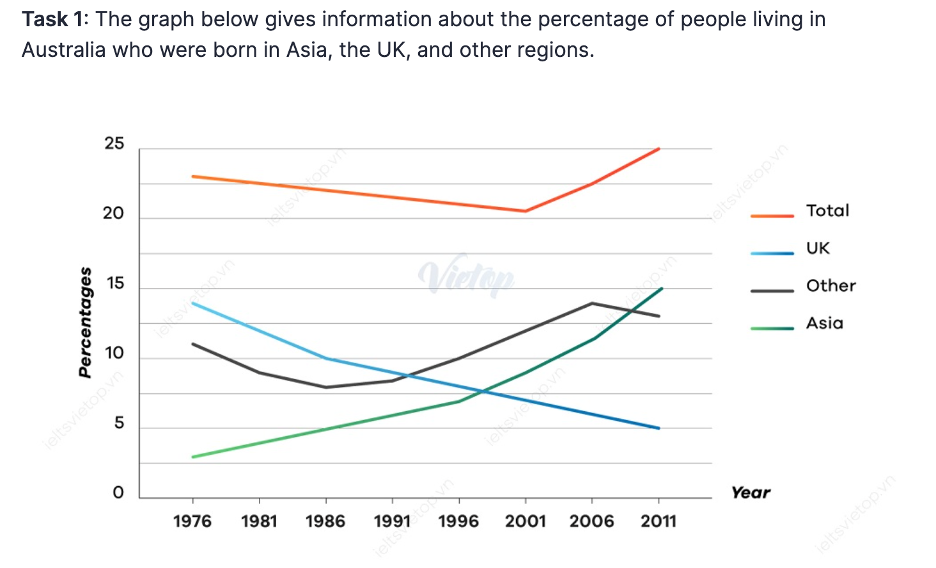
The line graph illustrates the proportion of Australian residents who are Asian, England and other regional people between 1976 and 2011.
In general, there were wholly different patterns over three categories. Moreover, the total percentage of international people in Australia went down slightly over the 1976-2001 period, with albeit a swift rise during the other years.
In 1976, commencing at 14%, the rate of England people in the country descended steadily and stayed at a low of 5% in 2011. Meanwhile, the number for Asian people witnessed an opposite trend, with a beginning at only 2.5% in 1976, then increasing gradually in between and reaching a peak of 15% in 2011.
On the other hand, the percentage of people from other regions living in the nation experienced a moderate decline from 11% to 7.5% between 1976 and 2011, followed by a significant increase to 14% in 2006 and a negligible fall to 12.8% in 2011. Finally, these inhabitants accounted for about 22.6% of Australian population in 1976, followed by a stable decrease to 20% in 2001 prior to a remarkable climb to 25% in 2011.
Task 2:
In spite of the typical nine to five jobs, employees tend to work far longer in light of financial incentives and their career development. From my perspective, I do believe that this situation is detrimental to the well-being of the workers.
To begin with, nowadays in most of companies and corporation the measurement of working performance is based on the quality of deliverables that people committed to rather than the way they come to work on time and complete their assignments as much as they can within eight working hours, which is regarded as the main reason for longer working of staff members. To make a move higher up the career ladder, young adults are willing to devote 10 hours or even 12 hours a day to their projects with certainly successful results. Moreover, they strive to seek an opportunity to handle larger scope of work in order to impress their executives. The great dedication, in turn, boost their occupational status and makes them have higher bonuses.
On the other hand, by making room for extra work, people will have less leisure time or rarely go to gym or not sleep enough at worst. People working in these conditions are likely to suffer chronic muscular and joint pain because they are devoid of robust physical health. This, coupled with prolonged anxiety and perpetual pressure to meet deadlines and required targets, can result in crippling depression and committing suicide. In particular, 45% of suicidal deaths in Japan reported in 2010 were due to constantly excessive workloads.
In conclusion, in this paced-world, youngsters are under high pressure to work more time for rapid promotion and good compensation from their organizations. Unfortunately, this practice brings about many drawbacks with regard to their quality of lives.

I
Top answer
In future, please DO NOT post more than one task per thread. --------------------------------- Task 1: The line graph [ 1 ] illustrates tracks the changes, between 1976 and 2011, in the proportion s of Australian residents who are Asian, were born in [ 2 ] England the UK, Asia, [ 3 ] and or other regions. regional people between 1976 and 2011 .
- In future, please DO NOT post more than one task per thread.
- --------------------------------- Task 1: The line graph [ 1 ] illustrates tracks the changes, between 1976 and 2011, in the proportion s of Australian residents who are Asian, were born in [ 2 ] England the UK, Asia, [ 3 ] and or other regions.
- regional people between 1976 and 2011 .
- In general, [ 4 ] there were wholly different patterns over three categories.
- Moreover, t he total percentage of international overseas-born people residents in Australia went down slightly over the 1976-2001 period, with albeit until the early 2000s, but saw a swift rise during the other remaining years.
Get the Weekly English Kit 📬
New words, one handy idiom, and a 2-minute quiz — delivered to your inbox to keep your streak alive.
In future, please DO NOT post more than one task per thread.
---------------------------------
Task 1:
The line graph [ 1] illustrates tracks the changes, between 1976 and 2011, in the proportions of Australian residents who are Asian,
 0
0Task 2:
In spite of the Many people nowadays are working long hours, even those in typical nine-to-five jobs. [ 1] employees tend to work far longer in light of financial incentives and their career development.
0 Related Questions