
Please Help Me With This Writing Task 1?
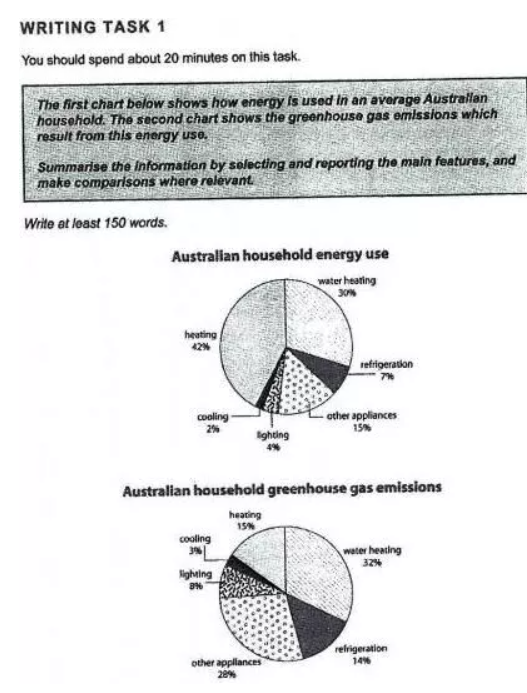
The first chart below shows how energy is used in an average Australian household. The second chart shows the greenhouse gas emissions which result from this energy use.
The pie charts compare the proportions of energy consumed from six different activities in an average household in Australia and the greenhouse gas emissions that are by-products of such activities.
It is evident from the chart that the three major energy-intensive activities are heating, water heating, and other appliances, and those three activities are also the leading causes of greenhouse gas emissions in Australian households.
Heating accounts for the largest percentage of energy used in Australia, at 42%, this is three times as high as the energy for other appliances. However, while heating is responsible for only 15% of the total greenhouse gases, other appliances make up nearly twice the amount. In addition, water heating ranks second in the energy consumption chart at 30%, but contributes the most greenhouse gases at 32%.
On the other hand, refrigeration’s proportions for energy use and greenhouse production are significantly lower, at around 7% and 14% respectively. Similarly, both cooling and lighting only account for small percentages, altogether comprise of nearly 10% on both charts.
Top answer
) in an average household in Australia and the greenhouse gas emissions that are produced by them. by-products of such activities . The first pie chart breaks down the energy use for six specific purposes, refrigeration, heating, water heating, cooling, lighting and operating other appliances, by a typical family in Australia.
- ) in an average household in Australia and the greenhouse gas emissions that are produced by them.
- by-products of such activities .
- The first pie chart breaks down the energy use for six specific purposes, refrigeration, heating, water heating, cooling, lighting and operating other appliances, by a typical family in Australia.
- The second pie chart breaks down the corresponding greenhouse gas emissions.
- It is evident from the chart that (Useless "filler" words.
Get the Weekly English Kit 📬
New words, one handy idiom, and a 2-minute quiz — delivered to your inbox to keep your streak alive.
The pie charts compare the proportions percentages of total energy consumed from (wrong word) six (What are they?) different activities (Tha
 0
0Sample essay:
The two pie charts compare the energy consumption and greenhouse gas emissions of six different types of appliances in a typical Australian household. These types are heating, water heating, cooling, lighting, refrigeration and “other appliances”.
Overall, two of them, heating and water heating, consume nearly three-quarters of the total energy, and they also acc
0 Related Questions