
Please help me with this Task 1 IELTS essay!
The chart below show the percentage of water used for different purposes in six area of the world.
Summerise the information by selecting and reporting the main features, and make comparisons where relevant.
Here is my essay:
Presented for consideration are the pie charts detailing figures for the proportion of water consumed in various reasons in several selected areas in the world. Overall, there was a significantly opposite trend among them.
Looking carefully at six particular areas, it appears indisputable from the data that the percentage of water used in agricultural purpose has priority. In more details, Central Asia, with the greatest percentage of water spend on agriculture, accounted for 88%. The second position belonged to Africa with 84%. Whereas on the other hand, Europe occupied for the lowest figures, at just over a third.
Turning to the water rate use for industrial purpose, the pattern was quiet different. Noticeably, it is unacceptable to ignore that while having the smallest proportion of water in agricultural use, Europe is completely different when it made up to over a half in water percentage for industrial field, earning the highest position. Remarkably, North America was followed with 48%. Specially, Central Asia experienced the lowest rate with only 5%.
Regarding to domestic use of water percentage, South Africa came top with 19%. Close behind was Europe, namely 15%. Both Central Asia and South East Asia had by far the least of water percentage, amounted for 7%.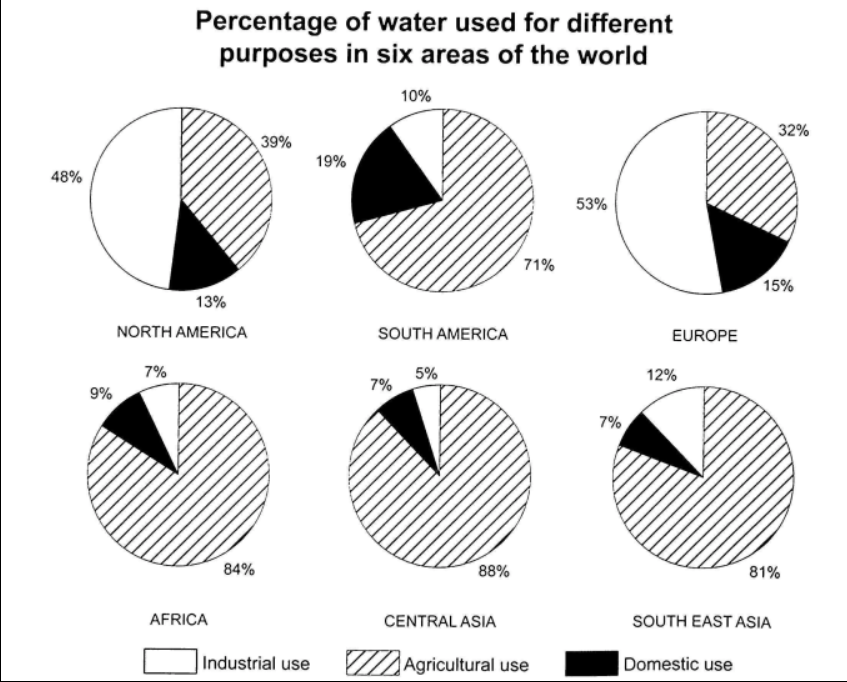
Top answer
I won't discuss the content of your essay. I'll help you with some vocabulary and wording. ) in several selected areas in the world.
- I won't discuss the content of your essay.
- I'll help you with some vocabulary and wording.
- ) in several selected areas in the world.
- ) trend among them.
- ) .
Get the Weekly English Kit 📬
New words, one handy idiom, and a 2-minute quiz — delivered to your inbox to keep your streak alive.
I won't discuss the content of your essay. I'll help you with some vocabulary and wording.
Presented for consideration are the pie charts detailing figures for the proportion of water consumed in various reasons (Is this the wrong word?) in several selected areas in the world. Overall, there was a significantly opposite ("
 0
0 Related Questions