
Please help me with my writting task 1.
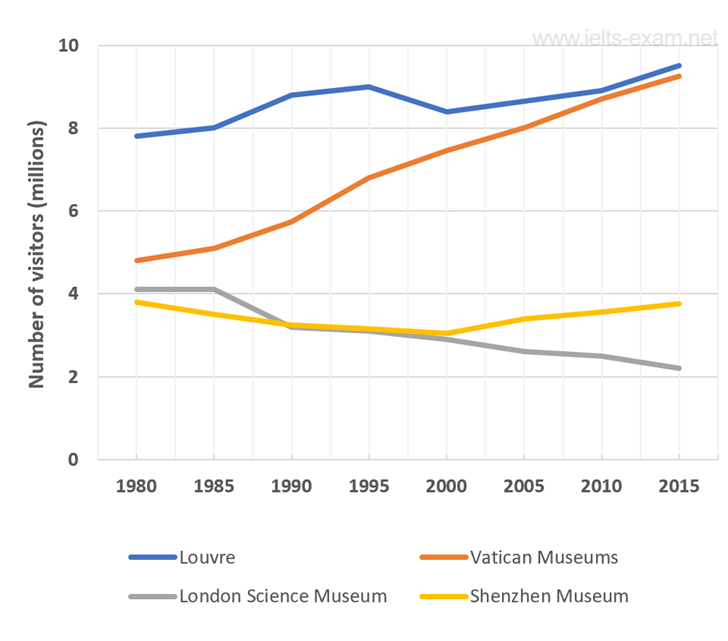
The line graph compares the number of tourists (in millions) who visit four different museums between 1980 and 2015. These are Louvre, London Science Museum, Vatican Museums and Shenzhen Museum.
Overall, Lourve attracted the most visitors throughout the entire period. London Science Museum was the only one that lost its visitors, whereas the number of people visiting Shenzhen Museum was constant. The total value increased substantially over the period, and that was mainly contributed by Vatican Museums.
In detail, in the initial five years, London Science Museum had 4 million tourists per year, while the number of visitors to Shenzhen Museum dropped from slightly under 4 million to around 3 million. At the same time, the two remaining museums attracted more tourists than those of the start point. Lourve continued to dominate, and Vatican Museums was clearly in the second place, which tried to catch up the dominant after 2010. From 1990 to 2000, London Science Museum had as many visitors as Shenzhen Museum, but they diverged around 2000, when the number of visitors for Shenzhen Museum went up and the last one decreased to its lowest level, at just over 2 million.
Top answer
The line graph compares the number of tourists (in millions) who visit (wrong verb form) four different museums between 1980 and 2015. These are the Louvre, London Science Museum, Vatican Museums and Shenzhen Museum. Overall, the Lourve attracted the most visitors throughout the entire period.
- The line graph compares the number of tourists (in millions) who visit (wrong verb form) four different museums between 1980 and 2015.
- These are the Louvre, London Science Museum, Vatican Museums and Shenzhen Museum.
- Overall, the Lourve attracted the most visitors throughout the entire period.
- The London Science Museum was the only one that lost its visitors , (wrong phrase) whereas the number of people visiting Shenzhen Museum was constant.
- The total value increased substantially over the period, and that was mainly contributed by Vatican Museum s.
Get the Weekly English Kit 📬
New words, one handy idiom, and a 2-minute quiz — delivered to your inbox to keep your streak alive.
The line graph compares the number of tourists (in millions) who visit (wrong verb form) four different museums between 1980 and 2015. These are the Louvre, London Science Museum, Vatican Museums and Shenzhen Museum.
Overall, the
 0
0 Related Questions