
Please help me with ielts writing task 1
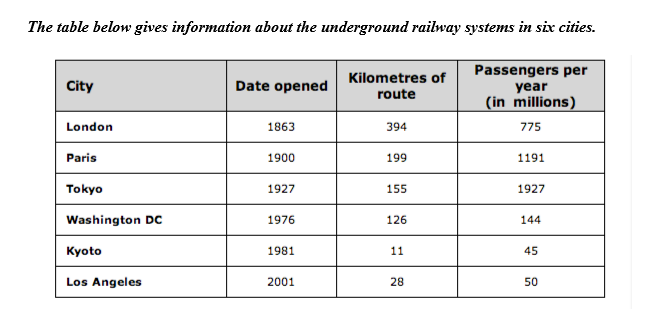
The table indicates data on the underground railway networks in six big cities.
The table compares the 6 systems in terms of their founding date, size and the number of passengers per year. It is clear that the three newest underground networks are more narrow and serve significantly less people than the three oldest ones.
In 1863, the first underground system of six cities was established in London, which is also the largest system with 394 kilometers of route and the second one is in Paris with only about half the size of that in London. However, it provides service for more people per year. While the Tokyo system, third in terms of size is used by the most of the passengers with 1927 million each year.
Of these three newer networks, the Washington DC underground is the most extensive with 126 kilometers of route, comparing to 11 kilometers and 28 kilometers for the Tokyo and Los Angeles system correspondingly. They have the youngest age shown on the table, but the number of people who they serve per year is almost 20 times less than the Tokyo system in this category.
Thank you so much!
Top answer
I would make some changes for clarity, correctness, and more natural speech. As follows: The table indicates provides data on the underground railway networks in six big large cities. The table compares the 6 six systems in terms of their founding date, size length, and the number of passengers per year.
- I would make some changes for clarity, correctness, and more natural speech.
- As follows: The table indicates provides data on the underground railway networks in six big large cities.
- The table compares the 6 six systems in terms of their founding date, size length, and the number of passengers per year.
- It is clear that the three newest underground networks are more narrow shorter and serve significantly less fewer people than the three oldest ones.
- In 1863, the first underground system of in the six cities was established in London, which is also the largest system with 394 kilometers of route .
Get the Weekly English Kit 📬
New words, one handy idiom, and a 2-minute quiz — delivered to your inbox to keep your streak alive.
I would make some changes for clarity, correctness, and more natural speech. As follows:
The table indicates provides data on the underground railway networks in six big large cities.
The table compares the 6 six systems in terms of their founding date, size length, and the number of passengers per year
 0
0 Related Questions