
Please help me to correct my task 1 ielts
The pie chart illustrates the primary reasons why agricultural areas became less effective. While the table presents how these reasons impacted three areas in the world, namely North America, Europe, Oceania in the 1990s.
At first glance it is clear that the main factor influencing land degradation was over- grazing. Whereas, Europe was affected the strongest by these causes, North America was impacted the least.
Over-grazing, which was the most important reason, accounted for 35% of the causes of land degradation compared to 28% of land degrade by over-cultivation. Another major influence was deforestation with just under a third of the degradation causes. However, 7% of “other” reasons caused land to be less productive.
Europe had the largest percentage of total land degradation with 23%. In contrast, only 5% of land was affected by degradation in North America, which was the least amount in total. There was a significant effect in Europe by deforestation with 9.8%, compared to 0.2% of this reason. On the other hand, Oceania was never influenced by over-cultivation but this problem predominated for land in Europe with 7.7% . In comparison, the largest proportion of land affected by over-grazing was in Oceania, with 11.3%. Meanwhile other ground that was impacted by over-grazing, was 1.5% and 5.5% respectively, was in North America and Europe.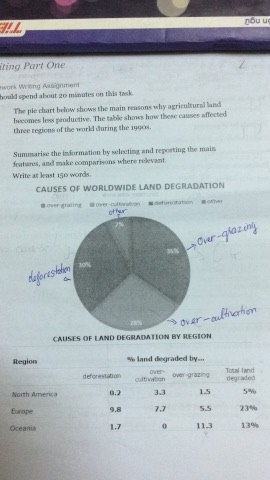
Top answer
The pie chart illustrates the primary reasons why agricultural areas became (wrong tense) less effective. While (what follows is a dependent clause. It is a fragment, not a sentence) the table presents how these reasons impacted (Reasons cannot impact anything.
- The pie chart illustrates the primary reasons why agricultural areas became (wrong tense) less effective.
- While (what follows is a dependent clause.
- It is a fragment, not a sentence) the table presents how these reasons impacted (Reasons cannot impact anything.
- " On-line shopping impacts the business at local stores.
- ) three areas in the world, namely North America, Europe, Oceania in the 1990s.
Get the Weekly English Kit 📬
New words, one handy idiom, and a 2-minute quiz — delivered to your inbox to keep your streak alive.
The pie chart illustrates the primary reasons why agricultural areas became (wrong tense) less effective. While (what follows is a dependent clause. It is a fragment, not a sentence) the table presents how these reasons impacted (Reasons cannot impact anything. Here are some sentences with the verb "impact." On-line
 0
0 Related Questions