
Please help me review this IELTS task 1
-----------------------------------------------
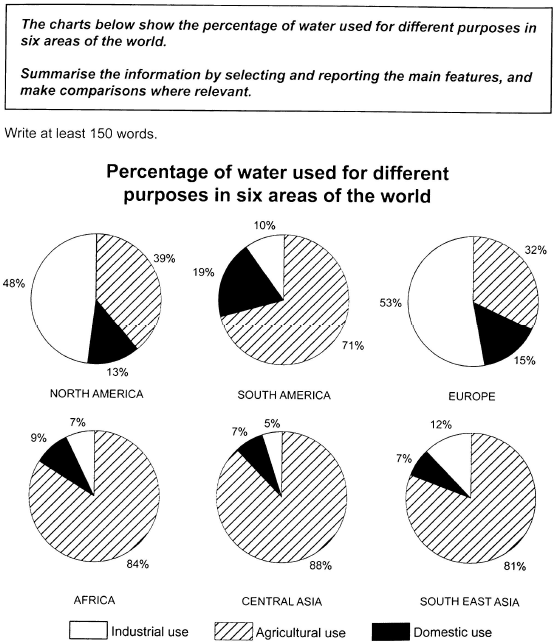
The six pie charts present the proportion of water which countries in six areas in the world used for various purposes including industry, agriculture, and domestic use.
Overall, in the developed countries (North America and Europe), the largest amount of water was utilised for production activities, whereas agriculture consume most of water use in the developing areas.
Regarding North America and Europe, people only used about 13 - 15% of water for their daily needs. The rest of water resource was provided for industry, which accounted for 48 to 53% of total water consumption. The water use for agricultural sector in also rather high, over 30% for each area. By contrast, the four less developed areas in South America, Africa, and Asia supplied almost their water source for farming activities with at least 71% of total volume. The consumption for household and industry made up a far small portion of less than 20%. Water use for two purposes in South America was pretty higher (approximately 30%) but its percentage still remained modest compared to that of North America and Europe.
Top answer
Please help me review this IELTS task 1 Your request is rather impossible. Consider these three sentences. 1) Please help me to carry my bags ( You carry the bags, but I assist you.
- Please help me review this IELTS task 1 Your request is rather impossible.
- Consider these three sentences.
- 1) Please help me to carry my bags ( You carry the bags, but I assist you.
- ) 2) Please carry my bags.
- (I carry the bags for you.
Get the Weekly English Kit 📬
New words, one handy idiom, and a 2-minute quiz — delivered to your inbox to keep your streak alive.
Please help me review this IELTS task 1
Your request is rather impossible. Consider these three sentences.
1) Please help me to carry my bags ( You carry the bags, but I assist you. )
 2) Please carry my bags. (I carry the bags for you. )
 3) Please help me by carrying my bags. (If I carry your bags, it will be good for you.)
1) Please help me review
 0
0The six pie charts present the proportion of water which countries in six areas in the world used for various three purposes, including industry, agriculture, and domestic use. (Various... including.. means that there were many purposes, and these were just three of them. There were more.)
Overall, in the
0 Related Questions