
Please help me check my Ielts task1 essay. Thanks so much for your help.
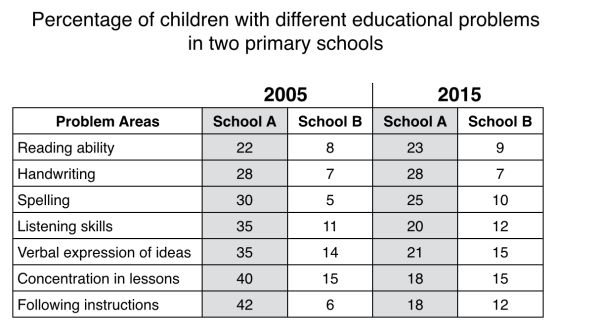
- Requirement: The table below gives information about the problems faced by children in two primary schools in 2005 and 2015.
- My essay:
The given table compares the proportions of pupils in two primary schools experienced seven different educational problems in the years 2005 and 2015.
It is clear that school A had higher proportions of children with all seven educational difficulties in both years compared to school B. In 2015, school A managed to reduce the incidence of most of the problems, while school B saw an overall rise in the percentage of children who were struggling.
In 2005, 42% of pupils in school A found it difficult to follow instructions, which was the highest figure shown on the table, whereas only 6% of pupils in school B experienced this problem. Similarly, the propotion of children had problems in spelling, listening skills, verbal expression and concentration in lesson in school A ranged from 30% to 40% while the equivalent figures for school B stood at 5% to 15%.
In 2015, the differences in the percentage of children with educational difficulties in both schools were not significant. The proportion of students in school A who struggled to follow instructions fell by 24%. In school B, the proportion of pupils who struggled with spelling and following instructions in 2015 doubled that figures in 2005, 10% and 12% compared to 5% and 6% respectively. In both schools, the incidence of struggling reading and handwriting problems increased slightly throughout the period.
Top answer
Please post essays, paragraphs, dialogues and other writing in the essay forum so a moderator does not have to move your post. htm
- Please post essays, paragraphs, dialogues and other writing in the essay forum so a moderator does not have to move your post.
- htm
Get the Weekly English Kit 📬
New words, one handy idiom, and a 2-minute quiz — delivered to your inbox to keep your streak alive.
Please post essays, paragraphs, dialogues and other writing in the essay forum so a moderator does not have to move your post.
https://www.englishforums.com/English/EssayReportCompositionWriting/Forum9.htm
 0
0The given (Do not write "given", "provided" or other such participle. It is not natural English. ) table compares the proportions of pupils in two primary schools experienced (ungrammatical sentence structure. You need to review how to write relative clauses.) seven differen
0 Related Questions