
Please Help Me By Evaluating My Essay. [Cambridge 14 Test 3 Task 1]
The diagram below shows how electricity is generated in a hydroelectric power station.
Summarise the information by selecting and reporting the main features, and make comparison where relevant.
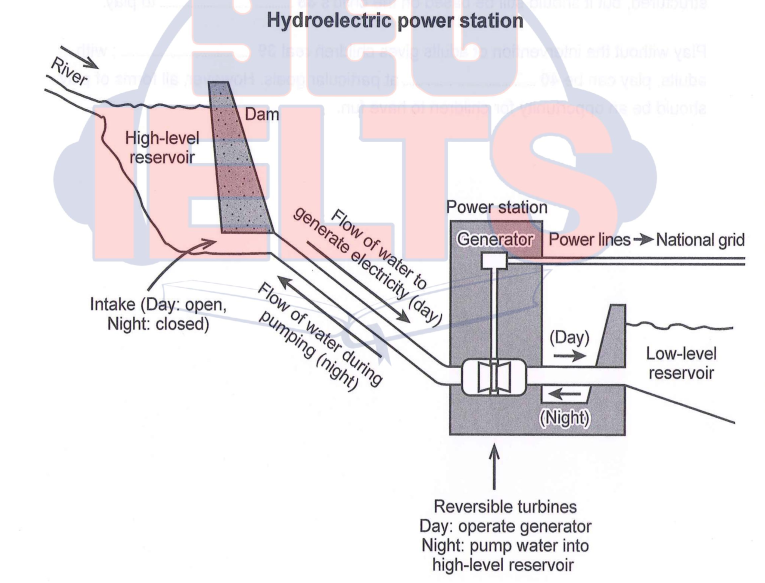
The provided diagram illustrates the process of electricity generation in the hydroelectric power plant.
In general, the entire process works back and forth in a cycle. In the day, it lets the water flow from the high-level reservoir to the low-level one and produces electricity using a reversible turbine which is also responsible for pumping the water back to the high-level reservoir at night.
As displayed in the diagram, during daytime, water from the river is channeled into the high-level reservoir which then travels to the reversible turbine via an opened dam. There, water is subsequently converted into electrical power which is then lead to the generator and to the power lines follow by the national grid. The excess water is directed to the low-level reservoir. At night, the station operates backwards where water from the low-level reservoir is pumped back into the high-level one by the reversible turbine for reuse.
Get the Weekly English Kit 📬
New words, one handy idiom, and a 2-minute quiz — delivered to your inbox to keep your streak alive.
 Related Questions