
Please check my writing task1
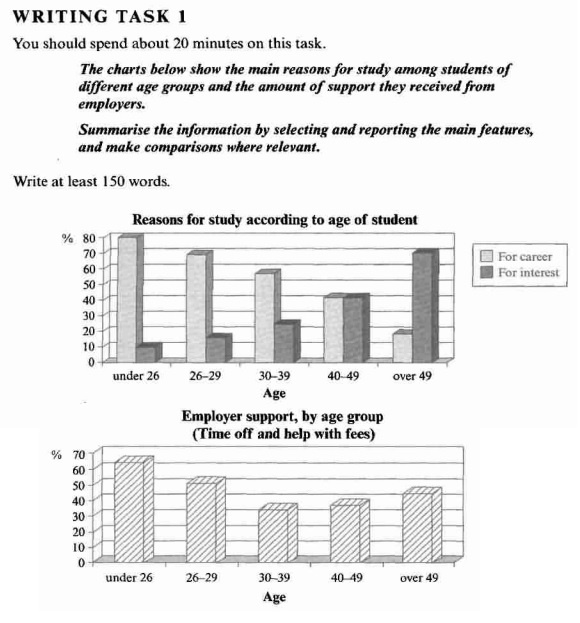
The bar charts provide information about what percentage of students study for career and interest in terms of five age groups in the range of under 26 years old to over 49 years old and proportion of people in each group who are supported by employers.
Overall, the percentage of students that work for career experiences downward trend, while other group shows an upward trend. Although the priority of students under 26 years old for the study is a job, it has the lowest importance for students over 49 years old. The employers do not support the range of age between 40 and 49 much.
Eighty percent of students under 26 years old study for finding a job, while 10% of them study for their interest. The percentage of students who study for career decreases with increasing the age and hits the low-point of approximately 19% for over 49 years old. the percentage of students who study for their interest rise and reach about 70% in the range over 49 years old.
The employers tend to support students have fluctuation. The proportion of students under 26 years old is highest, almost 63% and it falls to about 33% for rang between 30 and 39. Then it grows by about 10 percent for students over 49 years old.
Top answer
) provide information about (Vague) what percentage of students study for career and interest in terms of five age groups in the range of under 26 years old to over 49 years old and proportion of people in each group who are supported by employers. Your first paragraph is not good. You try to cram all the aspects of the figure into one complicated sentence.
- ) provide information about (Vague) what percentage of students study for career and interest in terms of five age groups in the range of under 26 years old to over 49 years old and proportion of people in each group who are supported by employers.
- Your first paragraph is not good.
- You try to cram all the aspects of the figure into one complicated sentence.
- It does not work out well.
- There is no rule that the first paragraph needs to be one and only one sentence.
Get the Weekly English Kit 📬
New words, one handy idiom, and a 2-minute quiz — delivered to your inbox to keep your streak alive.
The bar charts (How many bar charts?) provide information about (Vague) what percentage of students study for career and interest in terms of five age groups in the range of under 26 years old to over 49 years old and proportion of people in each group who are supported by employers.
Your first paragraph is not good. Yo
 0
0 Related Questions