
Please check my writing for task 1
You should spend about 20 minutes on this task.
The graph below shows the proportion of the population aged 65 and over between 1940 and 2040 in three different countries.
Summarize the information by selecting and reporting the main features and make comparisons where relevant.
You should write at least 150 words.
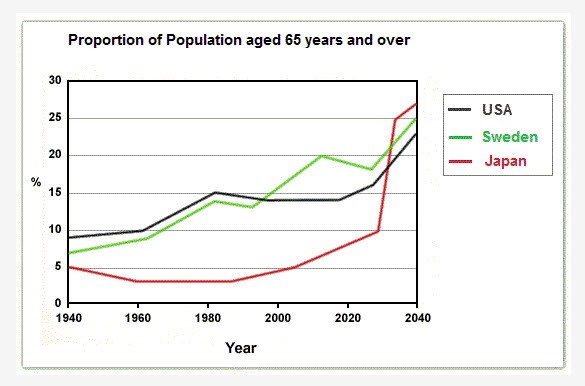
The line graph provides information about how the population of 65 age and over changes in three countries from past to future. Overall, each country has experienced an increase in the rate of elderly people. In addition, this trend of rising will continue in the future.
Between 1940 and 2000, the population of senior went up steadily in Sweden and USA, while it was almost the same in Japan. The rate of elderly people in Sweden almost tripled from 6% to 18% during 6 decades. Moreover, USA, which had the richest rate in elderly population in 1940, this rate reached at 15% in 2000.
From 2000 to 2040, at the end of this duration, USA will replace with Japan in terms of having largest rate in elderly population. The most remarkable change will be experienced by Japan that will have senior people with more than a quarter of its population. Second to that, Sweden will own a quarter one in 2040. the population of that will be around 22% in USA.
Top answer
Please read my advice for Task 1 essays: IELTS TASK 1: Hints, Tips And Advice Vocabulary Words For Task 1: Reference Post
- Please read my advice for Task 1 essays: IELTS TASK 1: Hints, Tips And Advice Vocabulary Words For Task 1: Reference Post
Get the Weekly English Kit 📬
New words, one handy idiom, and a 2-minute quiz — delivered to your inbox to keep your streak alive.
 0
0The line graph provides information about (That is not specific. Information can be many different things. Write exactly what is on the graph.) how the population of 65 age and over (It is the percentage of the population.) changes in three countri
0Sample essay (~185 words)
Paragraph #1 - Tell the reader all aspects of the graph, but do not mention any specific data content. Note that the time is divided into the past and the future. This is not a good task because it does not say when the predicted period begins.
The line graph compares the percentage of senior citizens (people aged 65 and over) in the USA, Sweden, an
0 Related Questions