
Please check my Task 1
You should spend about 20 minutes on this task.
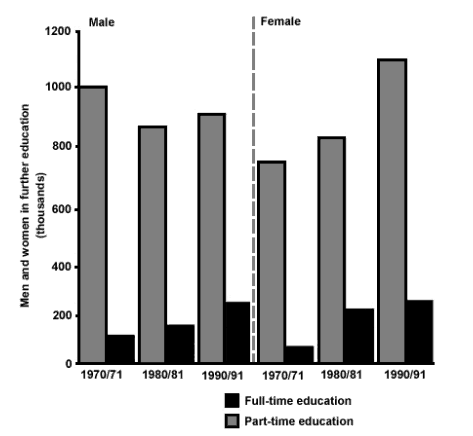
The chart below shows the number of men and women in further education in Britain in three periods and whether they were studying fulltime or part-time.
Summarise the information by selecting and reporting the main features, and make comparisons where relevant.
The bar charts depict the number of men and women (in thousands) who were pursuing tertiary education- full time or part time- in three time spans in the UK. The periods in question are 1970-71, 1980-81, and 1990-91.
It is clear that the number of enrollments for both genders in further education part time was well above those studying full time. However, although women grew in number in both the modes of education in all the years, men part-time enrollments decreased overall.
Throughout the period, the trajectory of men involved in full-time education fluctuated, towards a downward trend: from one million in the early 1970s to around 900 thousand in the years 1990-91. On the other hand, the men studying full time were around 100 thousand but increased steadily, numbering around 220 thousand at the third time period.
The part-time female students started the period with around 800 thousand, but irrespective of the slight increase in the second time period (1980-1981), they rose in number significantly, exceeding one million and a thousand in the early 1990s. Their full-time counterparts also grew three fold from 1970 to 1981, but then tapered off, reaching the number of the men in this mode of education in 1991 (220, 000).
Top answer
The bar charts depict the number of men and women (in thousands) who were pursuing tertiary education , full time or part time, in three time spans in the UK. The periods in question are 1970-71, 1980-81, and 1990-91. It is clear that (Those words are unnecessary; they do not describe the data.
- The bar charts depict the number of men and women (in thousands) who were pursuing tertiary education , full time or part time, in three time spans in the UK.
- The periods in question are 1970-71, 1980-81, and 1990-91.
- It is clear that (Those words are unnecessary; they do not describe the data.
- ) The number of part-time enrollments for both groups genders in further education part time was more than four times more than well above those studying full time.
- However, although women grew in number in both the modes of education full and part-time education in all the years, men 's part-time enrollments decreased overall.
Get the Weekly English Kit 📬
New words, one handy idiom, and a 2-minute quiz — delivered to your inbox to keep your streak alive.
The bar charts depict the number of men and women (in thousands) who were pursuing tertiary education, full time or part time, in three time spans in the UK. The periods in question are 1970-71, 1980-81, and 1990-91.
It is clear that (Those words are unnecessary; they do not describe the data. ) The number of part-time
 0
0 Related Questions