
Please check my IELTS task 1
The bar chart illustrates the comparison between the average number of pupils per class in six countries and the world average in 2006.
Overall, students on average in classrooms from Korea had the highest number compared with other countries. In addition, the number of pupils per class from five to eight years old was higher than the figure for those from eight to fourteen in six countries including the world average.
In 2006, The Korean had the largest primary school classes, around 40 students in a class. It is followed by The Mexican, Japanese and British pupils went to school at around 34, 32, 24 students per class respectively. Besides, the statistics in Iceland and Denmark show similar patterns with just 17 students in each class.
On the other hand, South Korea and Japan accounted for the highest lower secondary's students, at over 30 students per class. It is followed by Mexico and the UK, with the number of students in each class just 25. In Iceland and Denmark, students from eight to fourteen went to school, at about 22 and 19, respectively which was lower than the global average.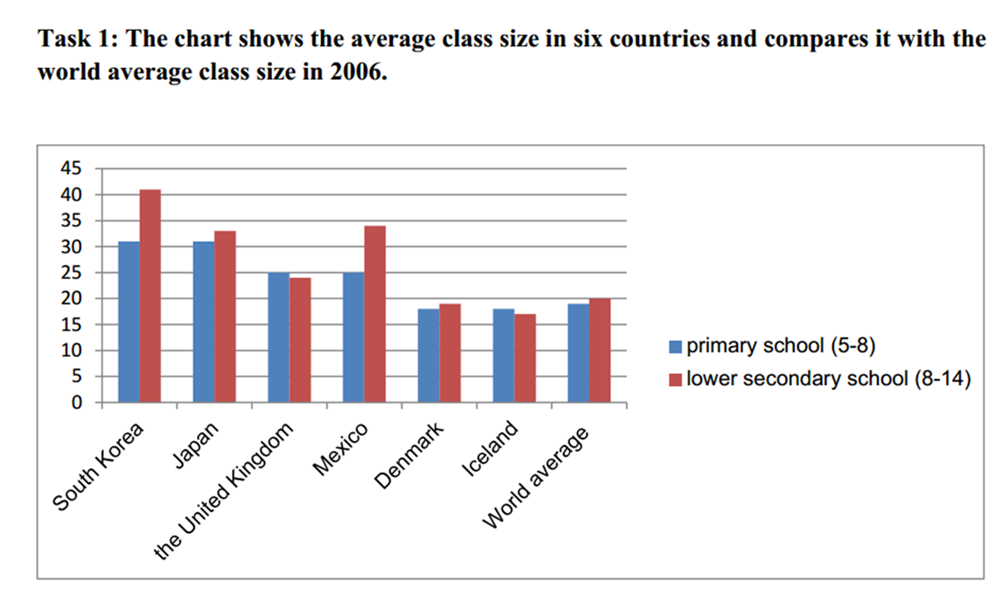
Top answer
The bar chart compares the number of pupils per class in six countries with the world average in 2006. Overall, students on average in classrooms from Korea had the highest number in six countries whereas, the proportion of students in Iceland is the lowest. In addition, the number of pupils per class from five to eight years old was lower than the figures for those from eight to fourteen in six countries and the world average.
- The bar chart compares the number of pupils per class in six countries with the world average in 2006.
- Overall, students on average in classrooms from Korea had the highest number in six countries whereas, the proportion of students in Iceland is the lowest.
- In addition, the number of pupils per class from five to eight years old was lower than the figures for those from eight to fourteen in six countries and the world average.
- In 2006, The Korean had the largest lower secondary school classes, around 40 students in a class.
- It is followed by The Mexican, Japanese ,British and Denmark pupils went to school at around 34, 32, 24 and 18 students per class respectively.
Get the Weekly English Kit 📬
New words, one handy idiom, and a 2-minute quiz — delivered to your inbox to keep your streak alive.
The bar chart compares the number of pupils per class in six countries with the world average in 2006.
Overall, students on average in classrooms from Korea had the highest number in six countries whereas, the proportion of students in Iceland is the lowest. In addition, the number of pupils per class from five to eight years old was lower than the figures for those from eight to fourtee
 0
0 Related Questions