
0
Akdom Posted 17 years ago
Grammar
"Past Probability + Tenses" combo
express probability in the past
STRUCTURE: modal + have + past participle
Where was John last night at 10?
1. He may have been at his home.
This is Past Tense. Right?
He has been in this country for 2 years. (Present Perfect)
2. He may have been in this country for 2 years.
Isn't #2 exactly same as #1?
The suspect had been to the crime scene. (Past Perfect)
3. The suspect may had been here.
The suspect may have had been here.
Ok, in this situation, I'm completely lost so far. When I tried to describe a Past Perfect situation using the STRUCTURE (modal+have+pastPartipal), the STRUCTURE doesn't seem to fit anymore.
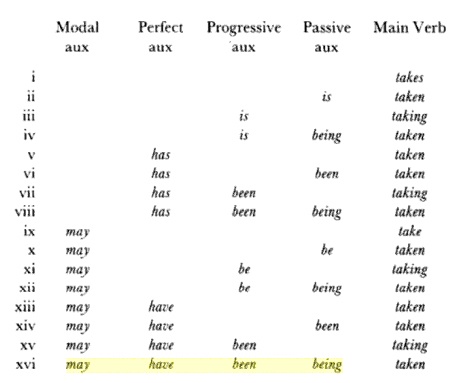
I also attached this Formula I found, but it also can't explain it clearly to me.
I need someone explain to me how to use different tenses when using modal auxiliary verbs to express Past Probability.
STRUCTURE: modal + have + past participle
Where was John last night at 10?
1. He may have been at his home.
This is Past Tense. Right?
He has been in this country for 2 years. (Present Perfect)
2. He may have been in this country for 2 years.
Isn't #2 exactly same as #1?
The suspect had been to the crime scene. (Past Perfect)
3. The suspect may had been here.
The suspect may have had been here.
Ok, in this situation, I'm completely lost so far. When I tried to describe a Past Perfect situation using the STRUCTURE (modal+have+pastPartipal), the STRUCTURE doesn't seem to fit anymore.
I also attached this Formula I found, but it also can't explain it clearly to me.
I need someone explain to me how to use different tenses when using modal auxiliary verbs to express Past Probability.
Top answer
1. This is Past Tense. - - Right 2.
- 1.
- This is Past Tense.
- - - Right 2.
- -- The form is the same; the meaning is not-- it includes the present moment.
- 3.
Get the Weekly English Kit 📬
New words, one handy idiom, and a 2-minute quiz — delivered to your inbox to keep your streak alive.
7 Answers
0
1. This is Past Tense. Right?-- Right
2. Isn't #2 exactly same as #1?-- The form is the same; the meaning is not-- it includes the present moment.
3. The suspect may have been here.-- This is the correct parallel.
4. The table is a paradigm of all theoretical forms; xvi is rare at best. The corpus of Contemporary American English offers n
2. Isn't #2 exactly same as #1?-- The form is the same; the meaning is not-- it includes the present moment.
3. The suspect may have been here.-- This is the correct parallel.
4. The table is a paradigm of all theoretical forms; xvi is rare at best. The corpus of Contemporary American English offers n
 0
00
May have/ Might have ( positive or negative )
It's possible that something happened or didn't happen in the past
For example:
Tom: I looked everywhere for my keys, and I just can't find them
Dina: You may have lost them at work.
That means,
The keys are lost, and Tom doesn't know where exactly he left them, he might have left them at work, at home, or somewhere el
It's possible that something happened or didn't happen in the past
For example:
Tom: I looked everywhere for my keys, and I just can't find them
Dina: You may have lost them at work.
That means,
The keys are lost, and Tom doesn't know where exactly he left them, he might have left them at work, at home, or somewhere el
00
YoungBuddyMay have/ Might have ( positive or negative )
Past Perfect is used to describe something that happened before a specific time in the past
- He had left before i arrived ( he had been here for sure before i came, but i didn't see him, because he left)
- He may had left before i arrived ( It's possible that he was there before
00
YoungBuddy- He may had left befI am sorry for the horrible mistake i made above ...
ore i arrived ( It's possible that he was there before i came, or he wasn't )
I don't think this makes any sense " The suspect may have had been here. "
The Modal auxiliary verbs are always followed by the base for
00
akdomIs the "structure" MODAL + HAVE, orYes. I assume that by "original form" you mean the bare infinitive or 'dictionary form'. Only the dictionarMODAL + HAD?
Isn't that when using a verb after modals, the verb must be original form?
00
Thank you, CalifJim, YoungBuddy, Mister Micawber
Here are what I've learned so far. See if I got them right.Expressing Past Probability with "may have" in different scenarios:
1 Simple Past
Where was he last night?He may have been at his house last night.
2 Present Perfect
He may have been in this country for years.(Not
00
akdomThe question is in the form of " simple past " , so the answer should be as well.1 Simple Past
Where was he last night? >>> Simple Past
He may have been at his house last night. >>> Present Perfect
Where was he last night
0 Related Questions