
On a medieval English passage
The passage below is from A History of the Index by Dennis Duncan.
(I only have a question on the bold-faced passage. But I present so long a text that I think it had something to do with the passage in question. So if you don’t need the background contextual understanding, you just skip all the others, and just focus on the bold-faced one.)
Let us imagine Therhoernen, then, looking at his page and thinking fast. A little over-inked, he reasons, but nothing a small adjustment shouldn’t fix. Loosen the type, give it a tap, then lock it all in again and try another pull. (The Bodleian’s J may be blurry, but the Berlin Staatsbibliothek have a copy of the Sermo whose J is neat, well-defined, a perfect impression.) The process may be slightly hit-and-miss, he tells his workmen, but at least the number is legible. It’s not the end of the world. Turning away, however, he performs a silent calculation. Has the extra effort been worthwhile? Who will use these numbers? Will they help to sell this slim sermon for a minor feast day?
An index represents value added, something for booksellers to work into their patter, ‘worth the asking price alone’; the poor old page number, by contrast, has yet to demonstrate that it is worth the printer’s trouble. In fact, a number of early printers were alert to the possibilities for indexing that the printed page opened up. They just didn’t see page numbers as the way forward, since there was
already another marker that could potentially do the job. Take, for example, the Chronicles of England, yet another immense history book, printed in St Albans in around 1486. As with the St John’s Polychronicon, its index comes with a brief paragraph of instructions:
Her begynnys a schort & breue tabull on thes Cronicles. And ye must vnderstond yt eueri leef is markid vnder with A. on. ij. iij. & iiij, & so forth to viij, all the letters. And what sum er ye fynd shor[t]li writin in this table ye shall find openli in the same letter.
If you are reading this and thinking that these don’t sound like ordinary numbers –what’s the capital A for? What does it mean, ‘all the letters’? –you are quite right. These are not page numbers; they are signature marks – the codes used by bookbinders to head off exactly the type of sequencing disaster that triggers the action in Calvino’s If on a Winter’s Night.
This is how they work. Imagine a newspaper. A short one, sixteen pages long. Now imagine opening it up at the middle, the centerfold. These pages – 8 and 9 – are, of course, two halves of the same sheet, folded down the centre. And if we took the sheet out and turned it over, we would find pages 7 and 10 on the reverse.
In fact, our whole newspaper is made up of just four sheets stacked on top of each other, each with that fold down in the middle. As readers, we want our pages numbered sequentially from 1 to 16. But the person who puts the newspaper together only needs to make sure that these four sheets – let’s call them i to iv – are stacked in the right order. The relationship between sheet numbers and page
numbers, however, is not a simple one:
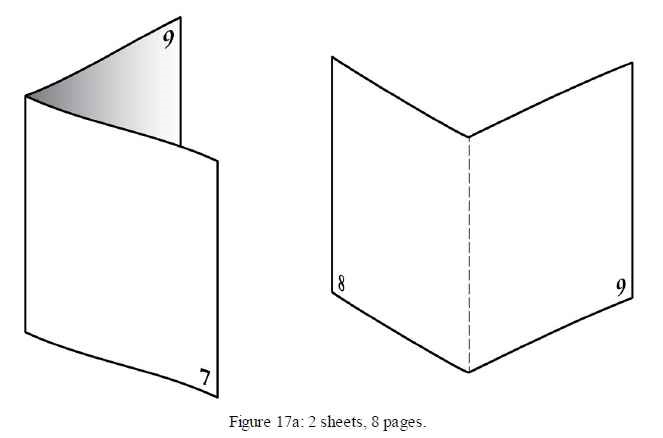
Figure 17a: 2 sheets, 8 pages.
Sheet Pages
I 1, 2, 15, 16
ii 3, 4, 13, 14
iii 5, 6, 11, 12
iv 7, 8, 9, 10
To stop our newspaper coming apart, we might staple the sheets together down the central fold like a magazine or a comic, or stitch them, again along the fold, like a chapbook or poetry pamphlet. A book – a hardback book, at least – is made up of series of these stitched gatherings, also known as signatures. The longer the book, the more signatures are needed. And if we call our first signature A, then B, then C, and so on, we can label each sheet with a mark indicating its signature and its position within it:
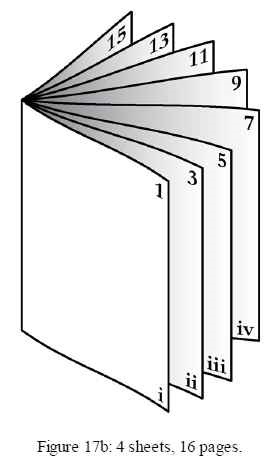
Figure 17b: 4 sheets, 16 pages.
Signature Pages
Ai 1, 2, 15, 16
Aii 3, 4, 13, 14
Aiii 5, 6, 11, 12
Aiv 7, 8, 9, 10
Bi 17, 18, 31, 32
Bii 19, 20, 29, 30
Biii 21, 22, 27, 28
Biv 23, 24, 25, 26
Ci 33, 34, 47, 48
Cii 35, 36, 45, 46
Ciii 37, 38, 43, 44
Civ 39, 40, 41, 42
…
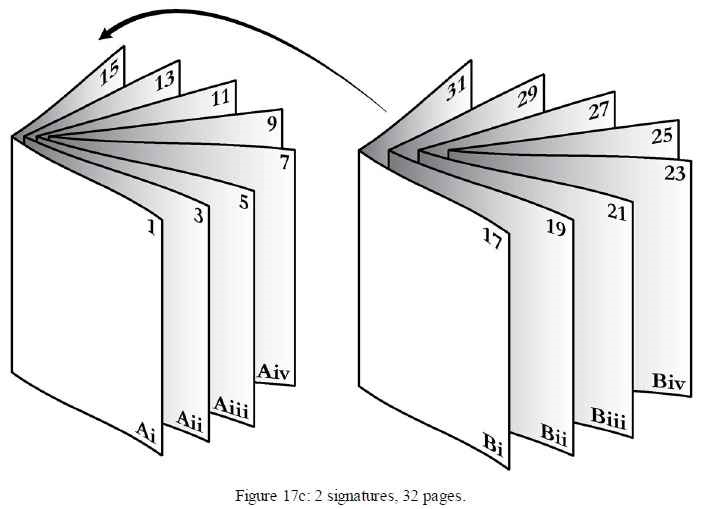
Figure 17c: 2 signatures, 32 pages.
------------
The bold-faced passage is, in fact, medieval English, so firstly, I convert it into modern English as follows:
? Her beginnings are short and brief table on these Cronicles. ? And you must understand its every leaf is marked under with A. on. ij. iij. & iiij, & so forth to viij, all the letters. ? And what some of you find shortly written in this table you shall find openly in the same letter.
(Is my conversion Okay?)
The background passages says that this passage is a brief paragraph of instructions about the book’s index.
And I will interpret this, in my own way, sentence by sentence.
? Her beginnings are short and brief table on these Cronicles.
Here, ‘Her’ is index. (Am I right?)
So it says the beginning of the index starts with short and brief table on these Cronicles. (Am I right?)
? And you must understand its every leaf is marked under with A. on. ij. iij. & iiij, & so forth to viij, all the letters.
So it says this book’s every leaf is labeled down below with Aij. Aiij. Aiiij, & so forth to Aviij, as with all the letters from A to Z. (Am I right?)
Even if I am right about it, still I have another question. Why is it from 1 to 7 every letter from A to Z? I think it’d be better if it was from 1 to 8, since the passages say that every sheet basically consists of 8 pages.
And another question, why ‘j’? In this context there is no reason it cannot be ‘k’ not ‘j’. (Am I right?)
? And what some of you find shortly written in this table you shall find openly in the same letter.
So it says what is written shortly or briefly in this table (that is, A. on. ij. iij. & iiij, & so forth to viij, all the letters) I can find openly in the same page letter with same page number.
I’m not even sure whether my question is written properly or not. But since this site is for the questions of the English learners as a second language. I think a question with some shortcomings can be excused. Thanks in advance.
Top answer
) Almost. Here begins a short and concise table on these Chronicles. And you must understand that every leaf is marked at the bottom with A on.
- ) Almost.
- Here begins a short and concise table on these Chronicles.
- And you must understand that every leaf is marked at the bottom with A on.
- ii, iii, iiii, & so forth to viii, all the letters.
- And whatever you find briefly written in this table you will find plainly at the same letter.
Get the Weekly English Kit 📬
New words, one handy idiom, and a 2-minute quiz — delivered to your inbox to keep your streak alive.
Stenka25(Is my conversion Okay?)
Almost.
Here begins a short and concise table on these Chronicles. And you must understand that every leaf is marked at the bottom with A on. ii, iii, iiii, & so forth to viii, all the letters. And whatever you find briefly written in this table you will find plainly at the same letter.
Stenka25
 0
0 Related Questions