
0
Catttt Posted 10 years ago
Vocabulary
meaning of movement
Does "movement" in the following text denote "the transformation of fleeting but decisive sensations of delight, surrender, disgust, surprise, ..."?
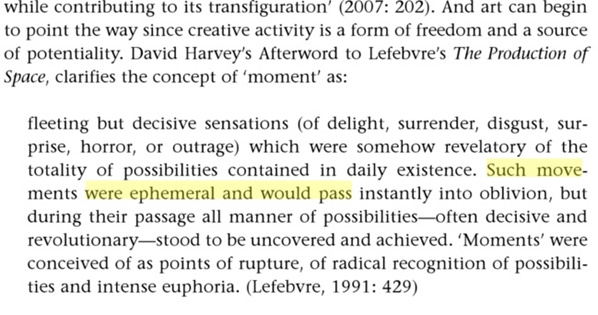
Another context:
In other words: through the artwork to ‘trouble the construction and commodification of urban identities’ in a way that
implicitly or explicitly draws in spectators as engaged participants and directs attention to the mechanism or movement of its own ‘labour’ or ‘coming into being’. Not surprisingly various
Another context:
In other words: through the artwork to ‘trouble the construction and commodification of urban identities’ in a way that
implicitly or explicitly draws in spectators as engaged participants and directs attention to the mechanism or movement of its own ‘labour’ or ‘coming into being’. Not surprisingly various
Top answer
) - "transformation" is not in the text. At least not the portion you provided. - As for your second mention of "movement" from another context, the meaning is likely the same, but context is insufficient for a clear determination.
- ) - "transformation" is not in the text.
- At least not the portion you provided.
- - As for your second mention of "movement" from another context, the meaning is likely the same, but context is insufficient for a clear determination.
- H.
Get the Weekly English Kit 📬
New words, one handy idiom, and a 2-minute quiz — delivered to your inbox to keep your streak alive.
5 Answers
0
- movements = sensations (of delight, disgust, etc.)
- "transformation" is not in the text. At least not the portion you provided.
- As for your second mention of "movement" from another context, the meaning is likely the same, but context is insufficient for a clear determination.
H.
- "transformation" is not in the text. At least not the portion you provided.
- As for your second mention of "movement" from another context, the meaning is likely the same, but context is insufficient for a clear determination.
H.
 0
00
All the highlighted portion says is that 'a movement/moment/sensation is brief and soon disappears.'
00
But how can "movement" mean "sensation? All dictionaries state it means something like "motion" or "change in state". Maybe you mean "the change of mood"?
00
red appleMaybe you mean "the change of mood"?I generally write what I mean. You have been reading philosophical texts, and philosoophers are notorious for coining their own definitions of words.
00
red appleBut how can "movement" mean "sensation?Having seen what you are reading, I'm a little surprised that you need to ask that.
Traditionally, sensations are movements of the soul.
H.
0 Related Questions