
I'm terrified of task 1 though my exam is coming. Please help correct my writing.
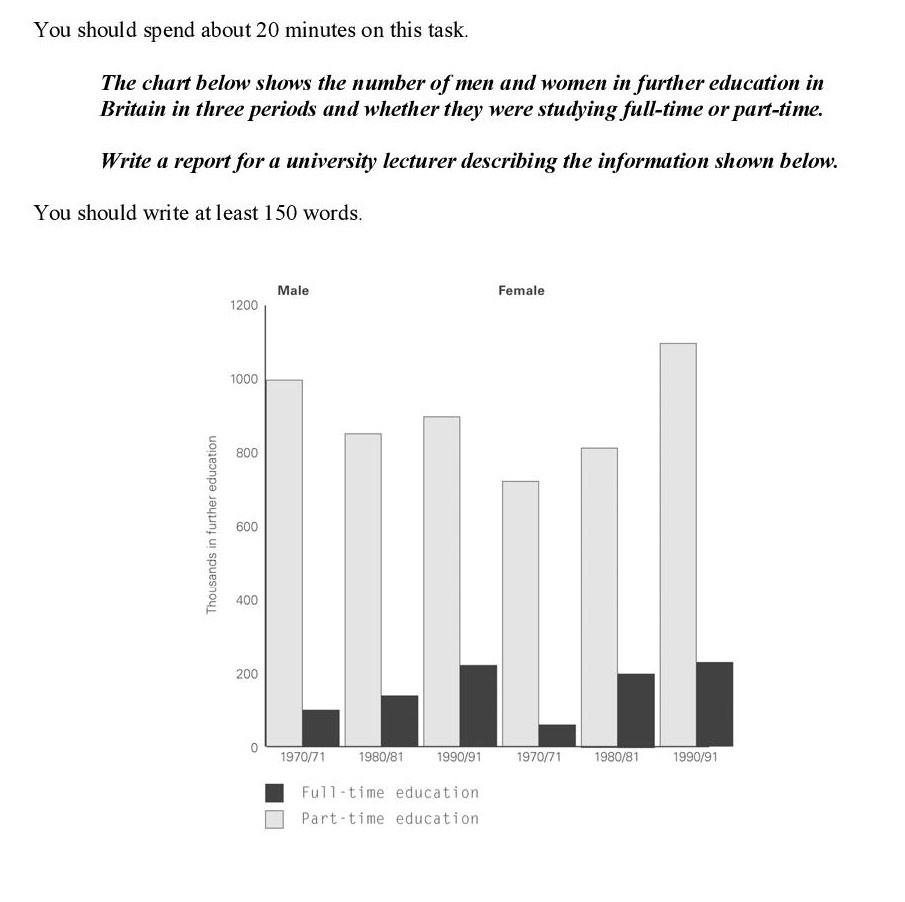
The bar chart illustrates the number of males and females participating in tertiary education in the UK. It shows if they were studying full-time or part-time and is divided into three periods.
Overall, the number of students engaging in part-time education vastly outnumbered those studying full-time. Although the two modes were relatively the same in the two genders, there were some differences, especially in 1990 where the number of female students studying part-time increased substantially.
With regards to full-time study, the number of male students grew slightly and consistently from under 100000 in 1970 to over 200000 in 1991. Whereas, females rose sharply over the first decade from below 100000 in 1970 to 200000 in 1981, then leveled off over the remaining period.
In terms of part-time education, there was a fluctuation in the number of male students over the period which were from 1000000 in 1970 down to over 800000 in 1981, then rose slightly during the latter decade. On the contrary, female students increased sharply and steadily from below 800000 in 1970 to just under 1200000 in 1991.
Top answer
The bar chart illustrates the number of males and females participating in [ 1] full-time or part-time tertiary education in the UK It shows if they were studying full-time or part-time and is divided into in three two-year periods – 1970/71, 1980/81 and 1990/91 . Overall, the number of s tudents engaging in part-time education vastly outnumbered those studying full-time. [ 2] Although the two modes were relatively the same in the two genders, there were some differences, Moreover, while the number of both male and female full-time university students increased modestly over those years, there was little notable change in the number of male part-time students in tertiary institutions.
- The bar chart illustrates the number of males and females participating in [ 1] full-time or part-time tertiary education in the UK It shows if they were studying full-time or part-time and is divided into in three two-year periods – 1970/71, 1980/81 and 1990/91 .
- Overall, the number of s tudents engaging in part-time education vastly outnumbered those studying full-time.
- [ 2] Although the two modes were relatively the same in the two genders, there were some differences, Moreover, while the number of both male and female full-time university students increased modestly over those years, there was little notable change in the number of male part-time students in tertiary institutions.
- The situation was different for females, especially in 1990 where [ 3] when the number of female students studying part-time increased substantially.
- With regards to full-time study, the number of male students grew slightly and consistently from under [ 4] 100 , 000 in 1970 to over 200 , 000 in 1991 , w hereas [ 5] the number of females rose sharply doubled over the first decade from below 100 , 000 in 1970 to 200 , 000 in 1981, but then leveled off over the remaining period.
Get the Weekly English Kit 📬
New words, one handy idiom, and a 2-minute quiz — delivered to your inbox to keep your streak alive.
The bar chart illustrates the number of males and females participating in [ 1] full-time or part-time tertiary education in the UK It shows if they were studying full-time or part-time and is divided into in three two-year periods
 0
0First, this graphic is terrible. It is an adulteration of the actual chart, which is much much clearer. Do not use practice tests from suspect sources. It will mislead you and confuse you even more.
https://www.ielts-exam.net/academic_writing_samples_task_1/642/
0The bar chart illustrates the number of males and females participating in tertiary education in the UK. It shows if they were studying full-time or part-time and is divided into three periods.
In the actual exam, there are two bar charts, one for men and one for women. It makes the introduction much easier to write.
Rea
0 Related Questions