
IELTS Writing task 1 - Process - Please help me check it out
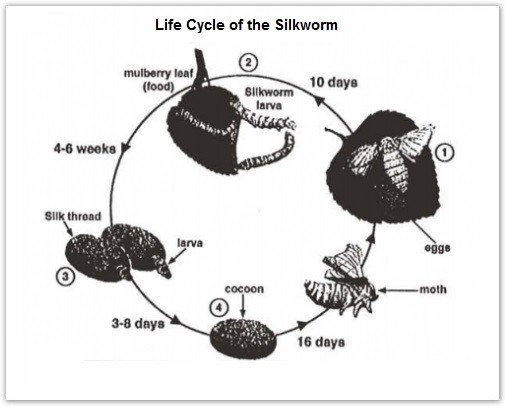
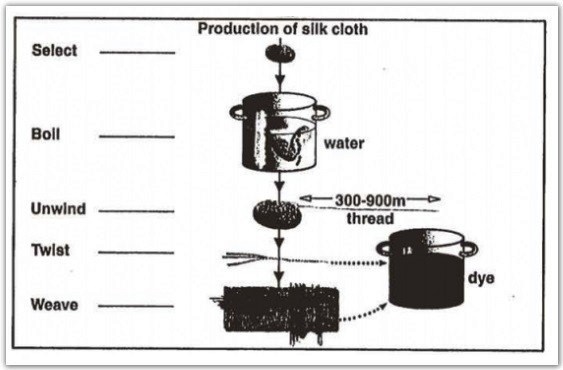
The diagrams below show the life cycle of the silkworm and the stages in the production of silk cloth.
Summarize the information by selecting and reporting the main features, and make comparisons where relevant.
------------------
The first process describes the silkworm’s life since they were born to the point of time that they are moths and the second process illustrates how a silk cloth is manufactured.
Overall, the first diagram has 6 steps and the other ones have 5 steps. The two diagrams basically make a detailed description of silk thread creating and the application of these materials for clothing manufacturing.
In the first and second stages of the first process, adult moth lays eggs onto a mulberry leaf and the silkworm larvas come out of those eggs ten days later. And, the mulberry leaf becomes the food for nurturing those silkworm larvas. After that, for 4 to 6 weeks, those larvas create the silk thread and that material roll around themselves. They turn into the cocoons from 3 to 8 days later and totally become moths when those cocoon age 16 days.
In the second process, the cocoon is selected and boil in water. Subsequently, the boiled cocoon is unwound in a thread that is long from 300 meters to 900 meters. In the next step, people twist three threads into one and it can be dyed or go through the weaving step before dying.
Top answer
You need to pay close attention to singular versus plural. That is very basic English. ) are moths and the second process illustrates how a silk cloth is manufactured.
- You need to pay close attention to singular versus plural.
- That is very basic English.
- ) are moths and the second process illustrates how a silk cloth is manufactured.
- ) Overall, the first diagram (You did not mention any diagrams in the opening paragraph.
- A process description is a bullet list of steps.
Get the Weekly English Kit 📬
New words, one handy idiom, and a 2-minute quiz — delivered to your inbox to keep your streak alive.
You need to pay close attention to singular versus plural. That is very basic English.
The first process describes the silkworm’s life from the time they hatch from eggs since they were born to the point of time that they (The a
 0
0 Related Questions