
IELTS-Task1
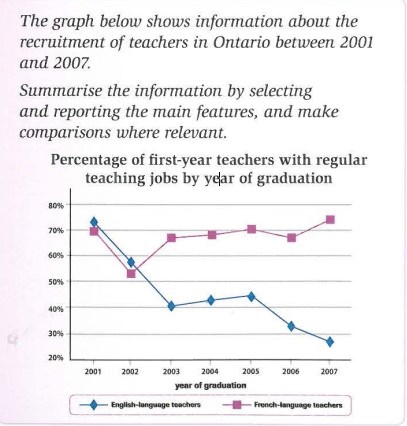
The data is shown the form of a line graph, which compares success in finding a job between English-language teachers and French-language teachers from 2001 to 2007 in Ontario.
Overall, except the period from 2001 to 2002, French-language teachers were more successful than English-language teachers.
According to the data, in 2001, the percentage of English-language teachers who could find a job were nearly 75%, compared to 70% of French-language teachers who could succeed it, so there was a small difference in numbers at this time. From 2001 to 2003, success of English-language teachers dipped in 2002 before increasing to less than 70%. After that, it increased into 68% in 2003. However, during the same period, the percentage of success in English-language teachers decreased sharply by about 35%.
During the period between 2003 and 2005, the percentage of a teacher who successfully could find the job in two groups increased slightly approximately 70% for French-language teachers and 45% for English-language teachers.
Between 2005 to 2007, although the percentage of French-language teachers reached less than 70%, it increased to above 70% in 2007. The percentage of English-language teachers fell by about 20% and reached nearly 27%.
Top answer
The data is shown the form of a line graph, which compares success in finding a job between English-language teachers and French-language teachers from 2001 to 2007 in Ontario. (Incomplete. What units of measure are on the graph?
- The data is shown the form of a line graph, which compares success in finding a job between English-language teachers and French-language teachers from 2001 to 2007 in Ontario.
- (Incomplete.
- What units of measure are on the graph?
- ) Overall, except the period from 2001 to 2002, French-language teachers were more successful than English-language teachers.
- According to the data, I n 2001, the percentage of English-language teachers who could find a job were nearly 75%, compared to 70% of French-language teachers who could succeed it , (ungrammatical) so there was a small difference in numbers at this time.
Get the Weekly English Kit 📬
New words, one handy idiom, and a 2-minute quiz — delivered to your inbox to keep your streak alive.
The data is shown the form of a line graph, which compares success in finding a job between English-language teachers and French-language teachers from 2001 to 2007 in Ontario. (Incomplete. What units of measure are on the graph? Are these all the teachers who happened to be changing jobs or reentering the workforce?)
Overall, except the period from 2001 to 2002, French-language t
 0
0 Related Questions