
IELTS Task 1 Wrting
WRITE DESCRIPTION HERE
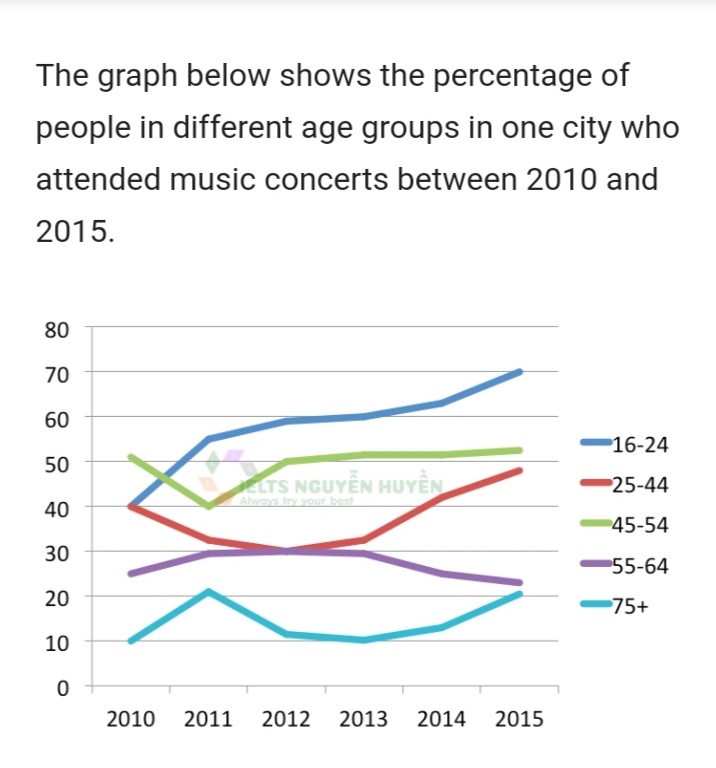
A glance at the graph provided reveals changes in the proportion of live music show attenders in different age groups in a city during the period from 2010 to 2015.
It is evident that while there was a steady rise in the percentage of the youngest group, the other ones saw some fluctuations over the years.
In 2010, approximately 40 percent of people aged 16 to 24 attended music concerts. The following one year experienced a moderate growth in this percentage to somewhere in the vicinity of 55 percent. This was followed by a period of exponential climb with the percentage of people in this group reaching a peak of over 60 percent in 2015.
Turning to the other groups, the 25-44 and 45-54 age groups' attendance at music concerts declined by about 10 percent from highs of over 40 percent and 50 percent; however, the figures for the two remaining groups achieved a gradual increase to 30 percent for the 55-64 age group and 20 percent for the eldest group. In 2015, there was a substantial fall in the percentage of people aged 55-64 to somewhere between 22 and 23 percent, whereas, the number of audiences in the three other age groups increase compared to 2010 despite small drops in the proportion of those in the 25-43 and 75+ age group. The figures for the 25 - 44, 45 - 54 and above 75 age groups ended around 49 percent, 52 percent and 21 percent respectively
Top answer
A glance at the graph provided (The essay examiner requires that you study the graph carefully, not just glance at it. ) in the proportion of live music show attenders (not a valid word) in different age groups in a city during the period from 2010 to 2015. (Your first paragraph is incomplete.
- A glance at the graph provided (The essay examiner requires that you study the graph carefully, not just glance at it.
- ) in the proportion of live music show attenders (not a valid word) in different age groups in a city during the period from 2010 to 2015.
- (Your first paragraph is incomplete.
- What are the age groups?
- ) It is evident that while (That conveys no information.
Get the Weekly English Kit 📬
New words, one handy idiom, and a 2-minute quiz — delivered to your inbox to keep your streak alive.
A glance at the graph provided (The essay examiner requires that you study the graph carefully, not just glance at it. This is very bad.)
reveals (poor word choice ) changes (not accurate.) in the proportion of live music show
 0
0 Related Questions