
IELTS Task 1 - Population Growth
Hi everyone! This is my writing for IELTS Task 1. Please help me to correct the writing. Thanks in advance!
The graph below shows population figures for India and China since the year 2000 and predicted population growth up until 2050.
Summarise the information by selecting and reporting the main features, and make comparisons where relevant.
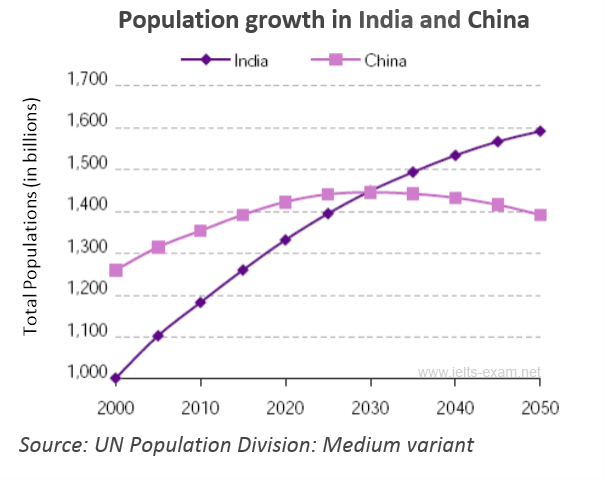
The line chart illustrates India and China populations since 2000 and how they will change over the course of 50 years.
Overall, the populations of either countries have risen since 2000. However, the population growth of India seems to stabler than that of China.
In 2000, China population stood at 1,2 billions. This figure experienced an upward trend that in 2010, the number of Chinese people grew to over 1,3 billions. A similar trend was witnessed in the number of Indian people. Particularly, in 2000, there were 1 billions of Indian citizens. After 10 years, however, the population dramatically rose to 1,2 billions, an increase of around 0,2 billion people.
It is noticeable that India population will outnumber China population. In detail, since 2010, population growth in China seems to level off. This figure is predicted to stop at the number of 1,3 billion people 40 years later. In contrast, over the same period, India population is said to have kept increasing significantly. To be more exact, by 2050, this country will have about 1,6 billion residents, 0,3 billions higher than China figure. Thus, during this period, the population figures of both countries are claimed to get across by the year of 2030, at over 1,4 billions.
Top answer
The line chart gives / plots the illustrates India and China populations starting in / from since 2000 and how they are forecast to will change over the course of 50 years. Overall, the populations of either (wrong word) countries have risen since 2000. ) than that of China.
- The line chart gives / plots the illustrates India and China populations starting in / from since 2000 and how they are forecast to will change over the course of 50 years.
- Overall, the populations of either (wrong word) countries have risen since 2000.
- ) than that of China.
- In 2000, China (wrong form) population stood at 1,2 billions .
- (wrong form) This figure experienced (Figures do not have experiences.
Get the Weekly English Kit 📬
New words, one handy idiom, and a 2-minute quiz — delivered to your inbox to keep your streak alive.
The line chart gives / plots the illustrates India and China populations starting in / from since 2000 and how they are forecast to will change over the course of 50 years.
Overall,
 0
0 Related Questions